
Primary Bedroom Ideas: 26 Designs That Actually Work
The primary bedroom is the only room you start and end every day in — but it's usually the last room any homeowner finishes. Below: the layout rules, lighting decisions, storage moves, and four budget plans for a primary bedroom that does what it's supposed to do — let you wake up well and wind down without thinking about it.
Updated May 2026 · 11 min read
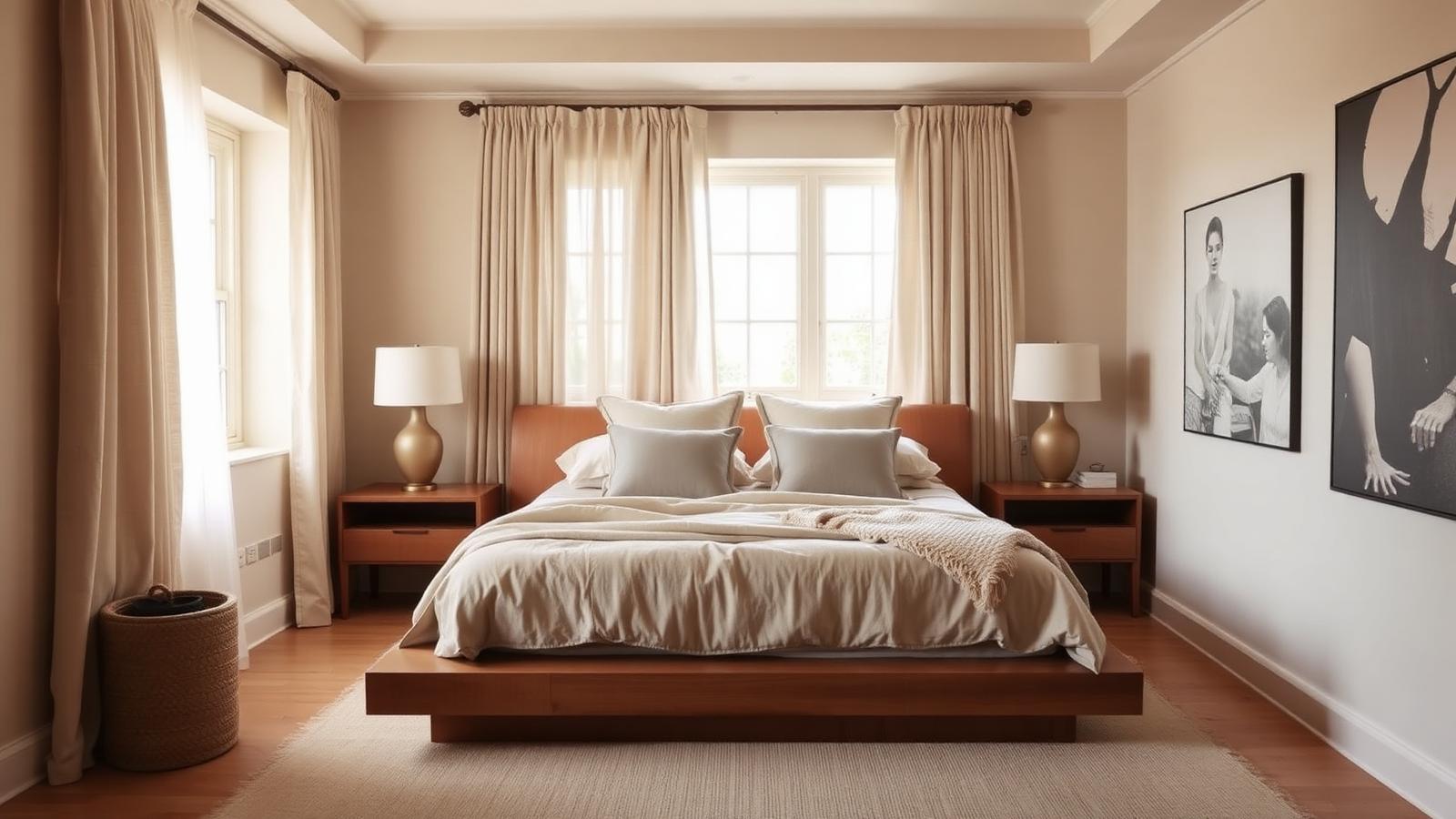
The bed on the longest wall, layered light at the headboard, one warm material upgrade — the three moves that turn any bedroom into a room you want to be in.
The Five Rules Every Primary Bedroom Follows
- Bed on the longest unbroken wall. Ideally opposite the entry door. The bed is the gravity of the room — placing it wrong makes every other choice harder.
- Three light sources at the bed. Overhead dimmer, nightstand lamps, sconces or floor lamp. Single overhead = bad. Three layers = real bedroom.
- One warm material upgrade. Linen sheets, a wool rug, oak nightstands. One natural-material splurge does more than three synthetic accents.
- Calm beats curated. One art piece above the bed, not a gallery wall. Bedrooms want fewer decisions on wakeup, not more.
- Hide the screens. TV in a cabinet or not at all. Phones dock in the hall. The single best sleep-quality change costs nothing.
26 Primary Bedroom Ideas
The full list — design moves, layout rules, and the small decisions that decide whether a bedroom feels finished or like a placeholder.
- 01
Anchor the bed on the longest wall
Opposite the entry door if possible. The bed is the room's center of gravity — every other piece arranges around it.
- 02
Layer three light sources at the bed
Overhead dimmer + nightstand lamps + wall sconces. Read-mode, conversation-mode, and sleep-mode in one room.
- 03
Pick nightstands taller than the mattress top
Bedside surface should hit 4–6 inches above mattress height. Lower nightstands force lamps you can't reach.
- 04
Hang art at 60 inches on center
Average eye height. Above-bed art bottom should sit 6–10 inches above the headboard, never touching it.
- 05
Use a 9x12 rug under a king bed
Rug extends 24–30 inches past the sides and foot of the bed. An 8x10 under a king reads cramped.
- 06
Add a bench at the foot of the bed
Visually finishes the bed; functionally holds the morning's clothes. 48–72 inches wide for a king.
- 07
Treat the headboard wall as the feature
Wallpaper, paneling, plaster, or a deeper saturated paint — the bed wall is the only wall worth a statement move.
- 08
Hang curtains 8–12 inches above the window
Floor-length. Curtain rod extends 6–10 inches past each side of the frame so curtains stack off the glass.
- 09
Choose one warm material upgrade
Linen sheets, a wool rug, or oak nightstands. One natural-material splurge does more than three synthetic ones.
- 10
Add a reading chair in any 4x4 corner
Lounge chair + side table + floor lamp. The single move that makes a bedroom feel like a suite.
- 11
Use bedside outlets and USB-C at 30 inches
Wall outlets at 30" off the floor (not 12") put plugs above nightstand height, eliminating the dangling-cord look.
- 12
Hide the TV or skip it
Inside a cabinet, on a lift, or not at all. A visible bedroom TV organizes every other piece around itself.
- 13
Match nightstand pair, not the bed
Pair-matched nightstands feel intentional. Trying to match nightstands to the bed frame usually reads like a hotel set.
- 14
Pick a 12-inch-deep dresser for small rooms
Standard 18–22" dressers eat 4 sq ft of floor. A 12" deep tallboy holds the same clothes and gives you back a walking path.
- 15
Use blackout drapery as a layer, not the only window treatment
Sheer + blackout combo lets you control morning light without committing the room to dark all day.
- 16
Built-in closets win over freestanding wardrobes
Elfa, IKEA Pax, or custom millwork. A wall-to-wall built-in closet uses 30% less floor for the same hanging space.
- 17
Plug-in sconces beat lamps in small bedrooms
Wall-mounted sconces free up nightstand surface and read more grown-up than matching lamps.
- 18
Mirror across from the window doubles light
A large mirror on the wall opposite the window bounces daylight deeper into the room. Skip the closet door mirror.
- 19
Pick bedding in three textures
Crisp cotton sheets, washed linen duvet, knit throw. Texture variation does what color variation does, without overload.
- 20
Use a small chandelier in a big room
Over the foot of the bed or centered in the room. A 28–36" chandelier transforms a builder-grade ceiling.
- 21
Hang full-length floor-to-ceiling drapes
Tops 4 inches from ceiling, hem brushing the floor. Makes 8-foot ceilings read as 9.
- 22
Use a runner on the side of the bed
If you can't fit a 9x12, runners on each side of the bed give your feet wool instead of cold floor on wakeup.
- 23
Add a fan-light combo with a quiet motor
Hunter or Minka. Ceiling fans rated 'silent' or under 30 decibels. The bad-fan-motor noise wakes light sleepers.
- 24
Pick a 14-inch-deep bookshelf for the wall
A single tall bookshelf on a long wall holds 200 books and adds soul without eating floor space.
- 25
Use one art piece, not a gallery wall
Above the bed, above the dresser. Gallery walls work in living rooms and reading nooks; bedrooms want calm.
- 26
Charge phones outside the room
Dock phones in the hall or office. The single best sleep-hygiene change costs nothing and makes the bedroom feel different the first night.
Four Budget Plans
From a $600 weekend refresh to an $18,000 built-in renovation — what the money buys and the order to spend it.
$600 Refresh
One weekend
- · Paint the bed wall ($60)
- · Linen duvet cover + pillows ($180)
- · Two ceramic table lamps with linen shades ($140)
- · 8x10 wool-blend rug ($180)
- · One large art piece above the bed ($40 thrifted)
$2,500 Full Refresh
Two weekends
- · Paint walls + ceiling ($250)
- · Upholstered headboard ($450)
- · All-new bedding — sheets, duvet, pillows ($400)
- · Linen curtains floor-length ($300)
- · 9x12 wool rug ($600)
- · Two ceramic lamps + bulbs ($200)
- · One framed art piece + bench at bed foot ($300)
$8,000 New Furniture
4–6 weeks
- · Solid wood bed frame ($1,400)
- · Two oak nightstands ($1,600)
- · Six-drawer dresser ($1,200)
- · Reading chair + floor lamp ($1,000)
- · Mattress (if needed) ($1,800)
- · Bedding, rug, art, curtains ($1,000)
$18,000 Built-In Renovation
6–10 weeks
- · Recessed lighting + dimmer rough-in ($2,200)
- · Hardwired sconces at bed ($1,400)
- · Built-in closet system, wall-to-wall ($6,500)
- · Wainscoting or paneled accent wall ($1,800)
- · New flooring or rug ($2,500)
- · Window treatments + hardware ($1,200)
- · Furniture + decor budget ($2,400)
The Bed Wall — One Decision That Sets Everything Else
Pick the longest unbroken wall — no door, no window, no closet entry. Center the bed on that wall. Then decide: is the bed wall the feature, or quiet? Feature bed walls get a deeper saturated paint, paneling, or wallpaper. Quiet bed walls keep the same color as the rest of the room and feature the bedding instead. Either works; doing both reads cluttered.
Lighting in Three Layers
The single biggest difference between a bedroom that feels intentional and one that feels like a placeholder is the lighting. Three layers, every time:
- Overhead on a dimmer. A flush mount or small chandelier with a wall dimmer. Used for cleaning and dressing, never for relaxing.
- Bedside lamps or sconces. Lamp shades that diffuse light downward (linen, paper, milk glass). Hardwired sconces with 30" arms swing where you need them; plug-in sconces work just as well at 1/4 the install cost.
- Reading corner or accent light. A floor lamp in a corner, an accent picture light, or LED tape behind a headboard. The third light is what makes the room feel finished after dark.
Storage That Stays Hidden
Visible storage in a bedroom reads as "to-do list before bed." Hidden storage reads as calm. The hierarchy:
- Built-in closets first. A wall-to-wall closet system (Elfa, IKEA Pax, custom) holds 2–3x what a freestanding wardrobe does in the same footprint.
- Tall dresser, not wide. A 12" deep tallboy uses 4 sq ft of floor; a 22" deep standard dresser uses 8 sq ft and holds the same.
- Under-bed storage drawers. Solid wood platform beds with integrated drawers, or rolling bins under any bed with 8"+ clearance. Off-season clothes, extra bedding, suitcases.
- Bench at the bed foot. The visible storage piece that earns its place — holds the throw blanket, the morning's clothes, and reads as design.
Frequently Asked Questions
What's the ideal layout for a primary bedroom?
The bed wall is the longest unbroken wall in the room, ideally opposite the entry door so the bed is the first thing you see. Nightstands flank the bed with 24–30 inches between bed edge and nearest wall or piece of furniture. Walking paths should be at least 30 inches wide. Dresser goes on a perpendicular wall, not opposite the bed (TV-style facing arrangements feel like a hotel, not a bedroom). A reading chair fits in any 4x4 corner with a floor lamp and a side table.
How big should a primary bedroom be?
The functional minimum for a queen bed with nightstands and a dresser is 11x12 feet (132 sq ft). 12x14 (168 sq ft) accommodates a king bed comfortably. 14x16 (224 sq ft) is the modern American 'primary suite' standard with room for a seating area. Anything over 300 sq ft starts to feel cavernous and benefits from a visual zoning move — a rug under just the bed, a low bench at the foot, or a small seating cluster pulled away from the bed.
What's the right primary bedroom paint color?
Three palettes work in almost every primary bedroom: warm white (Benjamin Moore White Dove, Sherwin-Williams Alabaster) for bright rooms with great light; soft warm greige (Benjamin Moore Edgecomb Gray, Sherwin-Williams Accessible Beige) for rooms with mixed light; deep saturated color (Benjamin Moore Hale Navy, Farrow & Ball Studio Green, Sherwin-Williams Urbane Bronze) for moody cocooning bedrooms with at least one window. Avoid pure cool gray — it reads sterile in bedrooms and ages poorly.
How much does a primary bedroom makeover cost?
A surface refresh — paint, new bedding, lamps, one piece of art, a rug — runs $600–$1,500. A full refresh — paint, bedding, lamps, art, rug, new headboard, window treatments — runs $2,500–$5,000. New furniture (bed, two nightstands, dresser, chair) adds $2,000–$8,000 depending on source. A built-in renovation (closet system, wainscoting, recessed lighting, electrical for sconces) adds $5,000–$15,000. A full primary suite addition runs $40,000–$120,000.
What's the single highest-ROI primary bedroom upgrade?
Bedside lighting. Most primary bedrooms have one overhead light, one lamp on each nightstand, and nothing else — and the overhead light is too bright, the lamps are too low, and there's no zone for reading or relaxing. Add wall-mounted sconces on a dimmer ($150–$400 plug-in, $600–$1,200 hardwired), upgrade the overhead to a dimmable LED, and add a floor lamp in the reading corner. Total: $400–$1,500. Effect: the room transitions from 'where you sleep' to 'where you wind down' in three layers of light.
Should the TV go in the primary bedroom?
Sleep researchers say no — bedroom TVs measurably reduce sleep quality and time. The compromise that works for couples who disagree: a small TV (under 43") mounted inside a cabinet that closes, or on a lift mechanism inside a bench at the foot of the bed. The visible-TV-on-the-dresser look is the most common bedroom design mistake; it makes every other piece of furniture in the room feel like supporting cast to a screen.