
Kids Room Ideas: 28 Designs That Grow With the Kid
A great kids room does two things at once — it fits the kid you have right now, and it stretches to fit the kid you'll have in three years without a full redo. Below: the neutral-base-plus-swappable-20% formula, age-by-age layout rules, paint and storage that survive growth spurts, and four budget plans from a $400 weekend refresh to a $6,000 built-in room.
Updated May 2026 · 10 min read
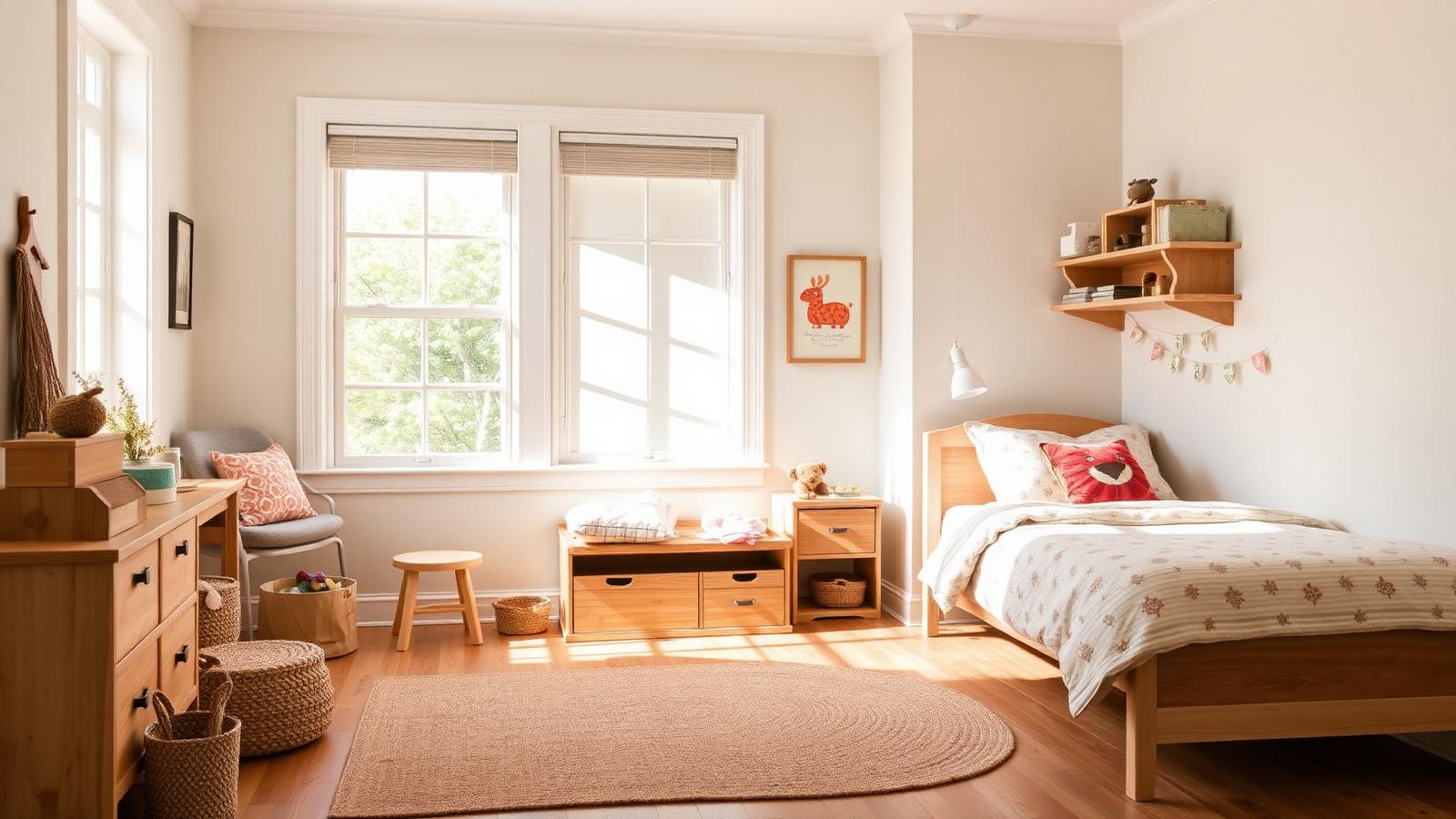
Neutral walls and oak furniture stay; bedding, art, and pillow covers swap as the kid grows. The room ages with them for $150 every two years.
The Five Rules Every Kids Room Follows
- Neutral base, swappable 20%. Walls, bed frame, dresser, and rug stay neutral and grown-up. Bedding, art, pillow covers, and shelf objects carry the personality and swap every couple years.
- Buy a full twin at age 3. Skip the toddler bed. A twin lasts from preschool to teen and resells for something. Toddler beds last 18 months.
- Storage at kid-height with open bins. Hooks at shoulder height, bins on low shelves, no lids. If a kid can't see or reach storage, the storage doesn't exist.
- Leave 60% of the floor open. Building, drawing, and rolling around happen on the floor. Crowded furniture pushes play onto the bed.
- Plan one refresh per age window. Toddler → big-kid (age 5–6), big-kid → tween (age 9–10). Each refresh costs $150–$300 in swappable items if you got the base right.
28 Kids Room Ideas
Design moves, layout rules, and small decisions that decide whether the room works for the kid living in it — not just the parent designing it.
- 01
Pick a neutral base, theme with the swappable 20%
Walls, bed, dresser, rug stay neutral. Bedding, art, pillow covers, decals carry the personality — and swap for $100 every 2 years.
- 02
Buy a full-size twin (not toddler bed) at age 3
Twin lasts from 3 to teen. Toddler beds last 18 months and resell for nothing.
- 03
Mount storage at kid-height
Bins, hooks, and shelves under 48" so kids can put their own things away. The single biggest predictor of a tidy kids room.
- 04
Use open bins, not lidded containers
Kids will not lift a lid. Open canvas, woven, or rope bins on low shelves get used; lidded plastic gets ignored.
- 05
Add a reading corner with a floor cushion
A 4x4 zone with a cushion, a basket of books, and a wall sconce. Pulls reading out of the bed and into a dedicated spot.
- 06
Hang art at kid-eye-height
30–40 inches off the floor for toddlers, 40–50 for big kids. Adult-height art is invisible to the actual room user.
- 07
Pick washable matte or eggshell paint
Benjamin Moore Aura, Sherwin-Williams Emerald, Behr Marquee. Marker, juice, and finger smudges wipe off without taking paint with them.
- 08
Use bunk beds with built-in storage for shared rooms
Bunks save floor for play; storage drawers under the bottom bunk replace a dresser.
- 09
Add a small desk by age 6
24" wide desk and chair near a window for homework, art, and Lego. Floor-level work doesn't scale to school-age.
- 10
Layer two light sources
Overhead dimmer + bedside reading light. Skip the single ceiling bulb — it's too bright for wind-down and too dim for play.
- 11
Choose blackout curtains, not just shades
Floor-length blackout drapes block morning light and absorb sound from the rest of the house. Single biggest sleep upgrade.
- 12
Pick a wool or wool-blend rug
Synthetic rugs trap spills and pill in a year. Wool blends hide marks, last 10+ years, and feel better under bare feet.
- 13
Mount hooks at kid shoulder-height
32–40" off the floor. Backpacks, jackets, and tomorrow's outfit get hung instead of dropped.
- 14
Use a single statement wall — not the whole room
Wallpaper, mural, or color block on one wall. Four walls of a theme is dated within a year.
- 15
Pick furniture without sharp corners
Rounded-corner nightstand, soft-edge dresser, no glass coffee table. Toddlers will test every corner you don't round.
- 16
Add a low art ledge for displaying drawings
An $18 IKEA Mosslanda picture ledge at 36" off the floor. Kids' art rotates in and out without nails.
- 17
Pick a dresser that turns into adult furniture
Solid wood, simple silhouette, no novelty knobs. The kids' dresser at age 4 becomes the linen storage at age 18.
- 18
Use a tall narrow bookshelf, not a wide low one
A tall bookshelf holds 3x the books and dedicates lower shelves to kid-reach, upper shelves to display.
- 19
Add a glow-in-the-dark night light, not a lamp on all night
A plug-in LED night light or moon lamp on the wall costs $15 and prevents the all-night lamp that disrupts sleep.
- 20
Pick washable bedding in three sets
Three sheet sets, two duvet covers. Rotation means clean bedding without laundry urgency on a sick day.
- 21
Build a Lego or art zone with a defined surface
Small table or floor mat that says 'projects happen here.' Containment is the only thing that keeps Lego out of the rest of the room.
- 22
Mount a full-length mirror by age 5
Kids dress themselves earlier when they can see themselves. Mount it securely to a stud at floor level.
- 23
Use a hamper, not a basket
Tall, lidded hamper with two compartments for lights/darks. Kids learn the system; baskets just look like extra toy bins.
- 24
Pick a clock with hands by age 5
Analog clock for telling time, plus a digital one for wake-up windows. The wake-up clock (red-light/green-light) ends 5am wakeups.
- 25
Leave 60% of floor open
Kids need floor for building, drawing, and rolling. Crowded furniture forces play onto the bed or out of the room.
- 26
Use a single rug, not a series of small ones
One 8x10 wool rug under the bed and play zone reads finished; three 3x5 rugs read cluttered.
- 27
Add closed storage for the parent stuff
Diapers, extra sheets, outgrown clothes — one closed cabinet for adult-managed inventory keeps the kid-visible shelves clean.
- 28
Plan a tween refresh at age 9–10
Swap bedding, art, and pillow covers. Repaint one wall. Add a beanbag or hanging chair. The same room reads age-appropriate for $250.
Four Budget Plans
From a $400 weekend refresh to a $6,000 built-in room — what the money buys and the order to spend it.
$400 Refresh
One weekend
- · Paint one accent wall ($40)
- · New bedding set — sheets + duvet ($120)
- · Two open canvas bins ($40)
- · Picture ledge with rotating art ($25)
- · Twin wool-blend rug 5x7 ($120)
- · Plug-in night light + new bedside lamp ($55)
$1,500 Full Setup
Two weekends
- · Paint room + ceiling ($180)
- · Solid wood twin bed frame ($350)
- · Mattress (if needed) ($250)
- · Three-drawer dresser ($300)
- · Small desk + chair ($180)
- · Wool-blend 6x9 rug ($220)
- · Bedding + art + storage bins ($200)
$3,500 Shared Room Setup
3–4 weeks
- · Bunk bed with storage drawers ($900)
- · Two twin mattresses ($500)
- · Tall narrow bookshelf ($250)
- · Two desks or shared 48" desk ($350)
- · Two chairs ($200)
- · 8x10 wool rug ($600)
- · Blackout curtains ($200)
- · Bedding, lighting, storage bins ($500)
$6,000 Built-In Room
6–8 weeks
- · Custom built-in bunk wall or window seat ($2,800)
- · Closet system upgrade ($900)
- · Hardwired sconces + dimmer ($600)
- · Wallpaper accent wall ($400)
- · New flooring or large wool rug ($800)
- · Bedding, art, desk, storage ($500)
Layouts by Room Size
- 8x10 single kid: Twin bed against the long wall, dresser opposite, small desk under the window. Floor open for play.
- 10x12 single kid: Twin or full bed centered on long wall, dresser perpendicular, desk with chair under window, reading corner in remaining corner.
- 9x10 shared: Bunk bed against one wall, shared three-drawer dresser opposite, small shared desk under window.
- 11x14 shared: Twin beds parallel along the long wall with shared nightstand between, two small desks or one 48" shared desk on opposite wall, rug and play zone in remaining space.
- 12x14+ shared: Twin beds on opposite walls with a defined play zone in the center, two dressers, art ledges above each bed.
Age Windows and What Changes
- Nursery to age 3. Crib, changing dresser, glider, blackout curtains, soft rug. The grown-up dresser doubles as a changing top with a removable pad.
- Age 3–6 (big-kid room). Swap crib for twin bed. Add hooks at shoulder height, low bins, a small art ledge, and a step stool to the closet rod.
- Age 6–9 (school-age). Add a desk by the window. Upgrade overhead lighting to dimmable. Add a clock with hands. Move toys into closed storage to make room for school materials.
- Age 9–12 (tween). Repaint one wall in their pick from your pre-approved swatches. Swap bedding, pillow covers, and art. Add a beanbag or hanging chair. Upgrade desk if needed.
- Age 13+ (teen). Bigger bed (full or queen if the room allows). New rug, new bedding, new desk chair. Wallpaper or paneling on the bed wall. Lock on the door is non-negotiable.
Shared-Room Survival Rules
- Defined zones. Each kid gets a bed, a nightstand or shelf, a hook, and a labeled drawer. Shared toys and books go in a central zone.
- Bunk beds for under 9x10 rooms. Bunks save floor for play; the floor space matters more than the visual height of beds.
- White-noise machine. Different sleep schedules, different bedtimes. White noise removes the friction.
- Curtains or canopy at each bed. Visual privacy for older kids; a ceiling-mounted curtain rod or canopy at the bed creates a personal zone.
- Plan for the split. Most shared rooms separate by tween age. Pick furniture that splits into two single-room setups, not built-ins you'd need to demo.
Frequently Asked Questions
How do you design a kids room that doesn't need to be redone every two years?
Pick a neutral base — walls, bed frame, dresser, rug — in finishes that read as 'kids' but aren't tied to an age (warm whites, soft sage, oak, jute). Then express age and personality with the easily-swapped 20%: bedding, art, pillow covers, a single statement wall decal, and shelf objects. A room built this way moves from toddler to big-kid to tween with $150 of changes instead of $1,500.
What size bed should kids have at each age?
Crib through age 2.5–3. Toddler bed (uses crib mattress) age 2.5–4 — optional; many kids skip straight to twin. Twin (38x75") from age 4 through tween, often through teen. Full (54x75") from age 8+ for kids who want room to sprawl or share with a parent during sick nights. Queen for teens 14+ if the room is large enough. Skip novelty car or castle beds — they lock the room into one moment of childhood and resell for nothing.
What's the best layout for a shared kids room?
Three layouts work, in order of small-to-large room: (1) bunk bed against one wall with shared dresser opposite, for rooms 9x10 and up; (2) twin beds parallel along the long wall with a shared nightstand between them, for rooms 10x12 and up; (3) twin beds on opposite walls with a play zone in the middle, for rooms 11x14 and up. Avoid the head-to-head along one wall — kids talk all night and nobody sleeps.
What paint colors work for kids rooms?
The colors that survive from toddler to teen: warm white (Benjamin Moore Simply White, Sherwin-Williams Alabaster), soft sage (Benjamin Moore October Mist, Farrow & Ball Mizzle), warm clay (Benjamin Moore Quincy Tan, Sherwin-Williams Latte), and pale dusty blue (Benjamin Moore Quiet Moments). Skip the saturated nursery pinks, primary yellows, and bright lavenders — they read 'baby' within 18 months and the kid will hate them by age six.
How much storage does a kids room need?
Plan for 3–4 cubic feet of clothing storage per child (one dresser plus a 24" closet rod), 2–3 cubic feet of toy/book storage at floor level for ages 2–8 (low bins kids can put things back in themselves), and one tall shelf for display objects, books, and craft supplies above kid-height. The mistake is over-buying storage on day one — you end up storing things you'd be better off donating.
What's a realistic budget for a kids room?
A neutral-base refresh — paint, bedding, one rug, one new lamp, two storage bins — runs $400–$900. A full setup with new bed, dresser, nightstand, and storage runs $1,200–$3,000 from IKEA/Target/Wayfair. A built-in room with custom bunk beds or built-in window seat runs $4,000–$8,000+. The biggest budget mistake: buying a $2,000 themed bedroom set that doesn't fit a 9-year-old. Spend on the bed and storage, not the theme.