
Murphy Bed Ideas: 18 Wall-Bed Designs & Build Plans
A good Murphy bed reclaims 25–35 sq ft of daily floor space, sleeps identically to a platform bed, and lasts 15–20 years. A bad one is a wall-mounted disappointment that doesn't fold right by year three. Below — the mechanisms, configurations, and three build tiers that decide which one you get.
Updated May 2026 · 9 min read
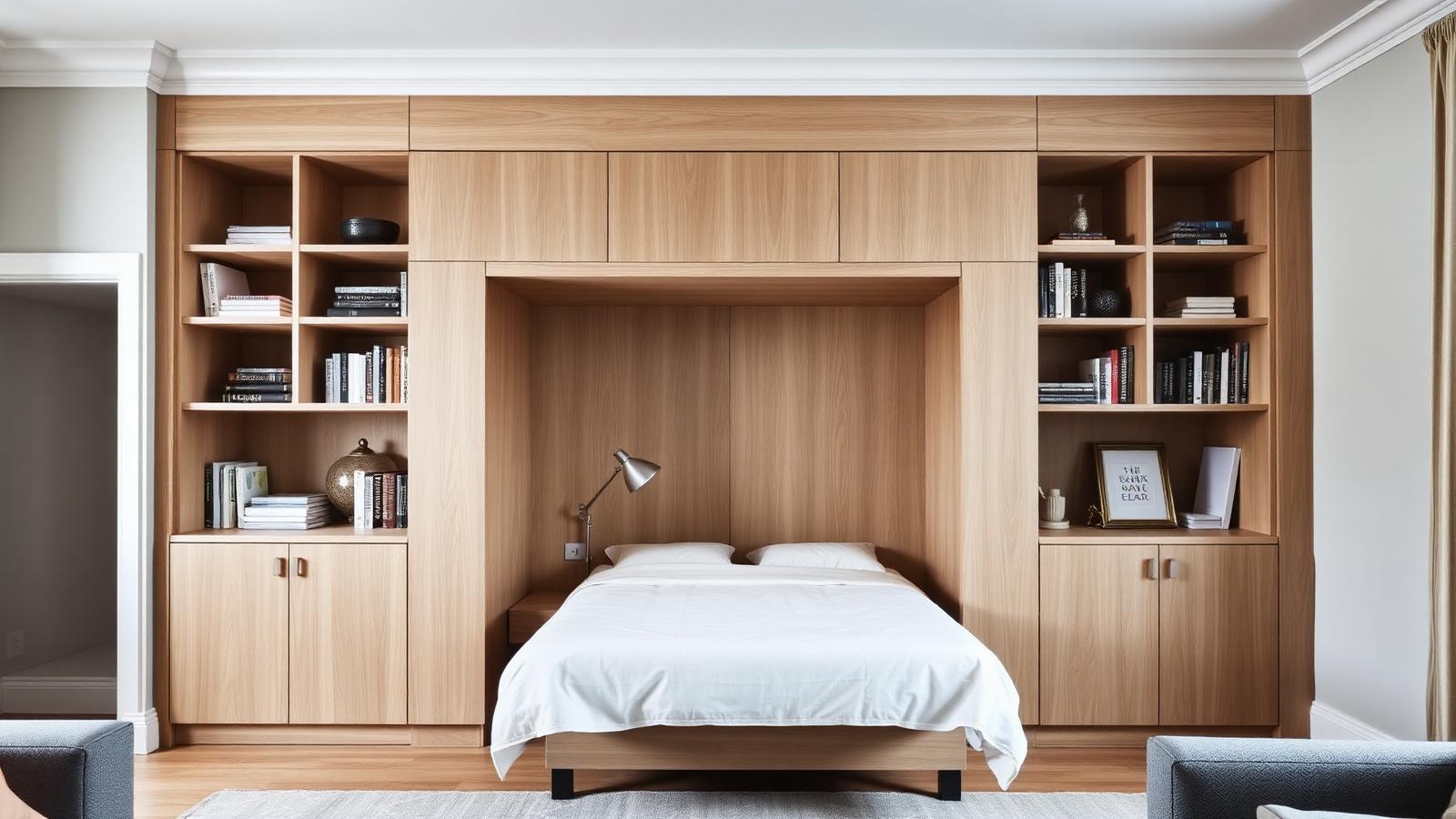
A vertical Murphy bed integrated into floor-to-ceiling white oak cabinetry — the build that defines the room when folded and disappears when down.
The Three Build Tiers
Tier 1: The IKEA Hack ($600–$1,200)
A kit mechanism (Lori, MurphyBedDepot, or Bestar) fitted into an existing IKEA Pax wardrobe surround. Best for renters and small budgets. The mattress accepts up to a 10-inch foam, the cabinetry doesn't quite read as custom, but the function is real. Weekend build with two people.
Tier 2: Branded Kit + DIY Surround ($1,400–$2,800)
A complete branded Murphy bed kit (Resource Furniture's lower line, Costco's NextBed, or Wall Beds USA) installed with a basic side-cabinet or trim surround. Solid mechanism, real mattress, looks intentional. Weekend build with intermediate carpentry skill.
Tier 3: Fully Custom Built-In ($3,500–$8,000+)
A local cabinet shop builds floor-to-ceiling cabinetry around a high-end mechanism (Resource Furniture, Murphy Wall Bed Co.) with integrated bookshelves, lighting, and matching drawers. Defines the room. 4–8 week lead time, professional install.
Vertical vs Horizontal: Which Configuration?
- Vertical (default): Mattress folds head-to-foot. Needs 86+ inches of ceiling height for queen. Smallest wall footprint. Best for most rooms.
- Horizontal: Mattress folds sideways. Works in rooms with 7–8 ft ceilings. Eats more wall length but stays under windows. Best for twins and fulls; awkward at queen+.
- Cabinet-style (Murphy chair / desk combos): Bed integrates with a desk or sofa that lifts when bed deploys. Clever, expensive, and only worth it if the secondary furniture is something you actually use daily.
Mechanisms Compared
- Gas piston — current standard. Smooth, quiet, weightless when properly adjusted. 10,000+ cycle rating. Worth paying for.
- Spring (torsion) — older design. Works, but heavier to lift and loses tension over 10–15 years. Common on budget kits.
- Electric — motorized lift. Solves nothing a quality piston doesn't, adds $800–$2,000 in cost, and breaks more often. Skip unless mobility is a real concern.
18 Murphy Bed Designs Worth Stealing
Studio & Single-Wall Designs
- Floor-to-ceiling white oak wall. Bed centered, bookshelves either side, LED tape lighting at the crown.
- Painted millwork in a single bold color. Forest green or deep navy makes the wall feel intentional even folded.
- Black metal frame, white surround. Industrial accent that reads as built-in even at IKEA-hack pricing.
- Slatted wood front. The bed face becomes a feature — vertical oak slats read as wall paneling when folded.
Home Office + Guest Room Combos
- Desk-integrated Murphy. Fold-out desk stays loaded when bed deploys — Italian Clei-style mechanism.
- L-shaped office wall with bed at the end. Desk on one wall, bed on the perpendicular wall, both visible at once.
- Sliding bookshelf hides the bed. Reading-wall storage that conceals the Murphy entirely.
- Open shelving across the top. Storage above bed footprint stays accessible when bed is down.
Built-In + Architectural Designs
- Arched alcove Murphy. Curved opening above the bed reads as a true alcove, not a closet door.
- Murphy + window seat. Bed flanked by built-in window seating with hidden storage.
- Floor-to-ceiling stained glass front. The folded bed becomes the room's art piece.
- Murphy bed in a closet conversion. Existing closet repurposed — bed disappears behind original doors.
Small & Renter-Friendly Designs
- Free-standing cabinet Murphy. No wall anchoring required — rental-safe.
- Pax-flanked IKEA hack. Bed centered between two Pax wardrobes; full storage wall under $1,200.
- Twin vertical for kid rooms. Reclaims play floor in a small bedroom.
- Horizontal queen under a low loft. Solves under-7-ft ceiling without giving up bed size.
Statement Designs
- Murphy bed inside a built-in library. Wall of books, hidden bed in the center bay.
- Two-color paneled front. The bed face becomes a graphic moment — half wood, half painted.
What to Spend Where
- Spend up on: the mechanism (gas piston, weight-adjustable), the mattress (quality 10-inch hybrid), and structural cabinetry (3/4" plywood, not particleboard).
- Save on: decorative trim, door pulls, paint finish — these are easy to upgrade later.
- Don't compromise on: install hardware. Use the structural anchors that ship with the unit, and locate every stud.
Keep Reading
Frequently Asked Questions
Is a Murphy bed comfortable to sleep on every night?
Yes, on a quality unit with a real mattress. Modern Murphy beds accept a standard 10–12 inch foam, hybrid, or innerspring mattress and sleep identically to a platform bed. The bed frame stays horizontal when down — it's only the wall mechanism that folds. Avoid units that ship with thin proprietary mattresses (usually 6–8 inches) — they're built to fold thin, not to sleep well.
Murphy bed vs sofa bed — which is better?
Murphy bed wins on sleep quality, longevity, and daily floor space; sofa bed wins on price, simplicity, and not requiring wall anchoring. Pick a Murphy bed if it'll be slept in 50+ nights a year or replaces a primary bed in a studio. Pick a sofa bed for the occasional guest 5–15 nights a year. The break-even on cost lands around year three for regular use.
What does a Murphy bed actually cost in 2026?
Three tiers: IKEA hack with a kit mechanism ($600–$1,200), branded kit assembled into existing furniture or DIY surround ($1,400–$2,800), fully custom built-in with cabinetry and integrated lighting ($3,500–$8,000+). Add $400–$1,200 for a quality mattress that folds well. Pro installation runs $400–$900 if you're not comfortable wall-anchoring the unit yourself.
Vertical or horizontal Murphy bed — which should I get?
Vertical (head-to-foot when down) is the default — more compact wall footprint and works for any mattress size. Horizontal (sideways when down) is better for low-ceiling rooms (under 8 ft), under-window installations, and twin or full mattresses. Queen and king horizontal units exist but eat 7+ feet of wall length — usually only worth it under sloped ceilings or in lofts.
Do Murphy beds damage the wall?
Properly installed Murphy beds anchor to studs and don't damage the wall any more than a heavy bookshelf — the mechanism transfers weight to the floor and the wall only provides anti-tip support. The risk is poor installation: anchoring to drywall alone, missing studs, or using the wrong screws. Always use the included structural hardware and locate studs with a quality finder. Renters: free-standing units with cabinet surrounds avoid wall anchoring entirely.
Which Murphy bed mechanisms are most reliable?
Gas piston mechanisms are the current standard — smooth, quiet, and rated for 10,000+ cycles. Spring mechanisms (older design) work but feel heavier and lose tension over 10–15 years. Avoid units without weight-adjustable mechanisms — the bed should feel weightless to lift regardless of mattress weight, and only adjustable systems can be tuned to your specific mattress.