
Dark Academia Bedroom: The Complete 2026 Style Guide
A dark academia bedroom blends the moody palette of a 19th-century library with the comfort of a modern bedroom. This guide covers exact paint colors, lighting setups, furniture sourcing, textiles, and a curated 24-item shopping list — so you can build the look without it feeling like a movie set.
Updated May 2026 · 9 min read
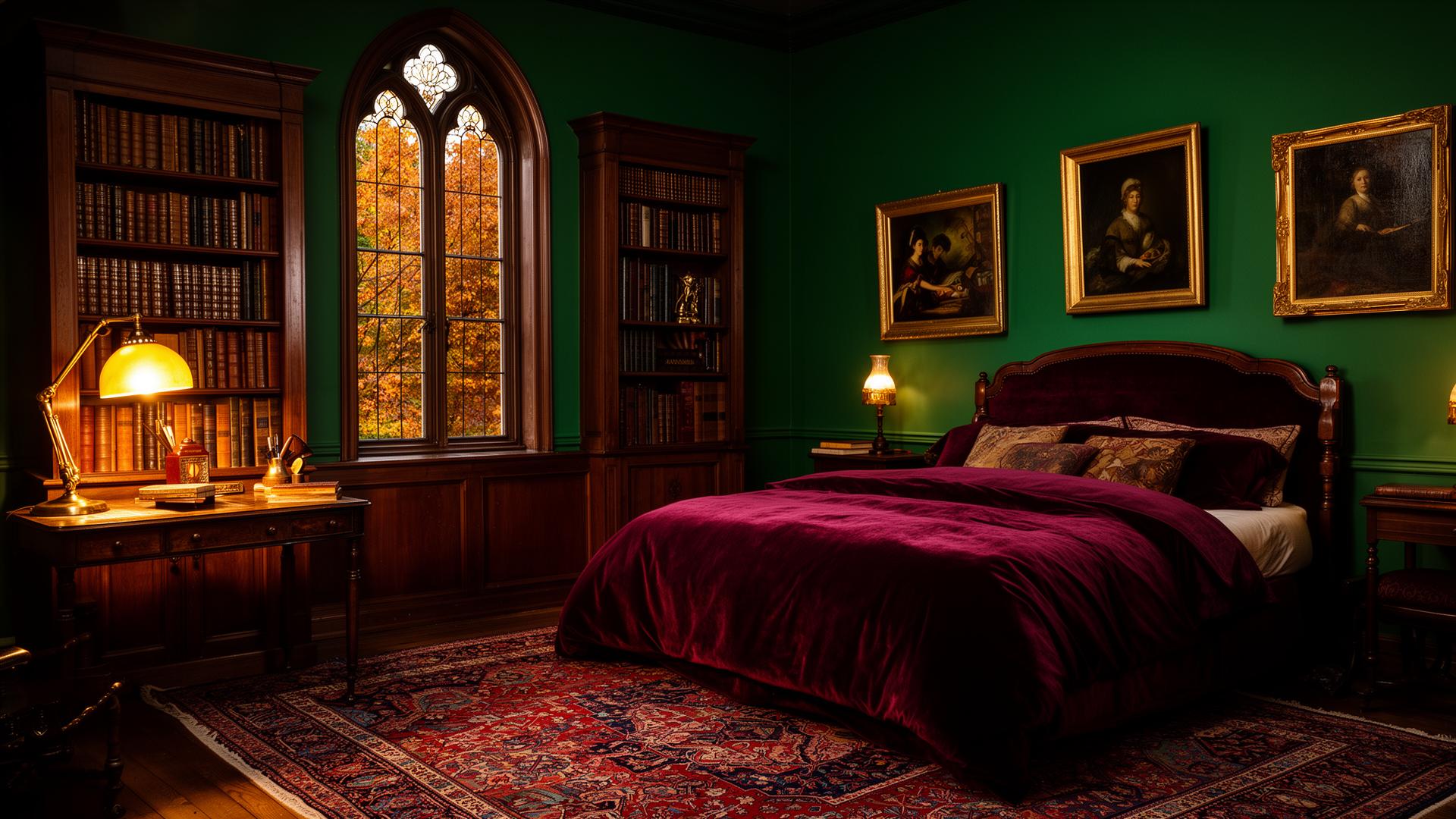
A textbook dark academia bedroom: saturated green walls, dark wood, oil paintings, and one warm light source.
The dark academia aesthetic exploded on TikTok in 2020 and has matured into a permanent interior style — closer to traditional English library design than to a passing trend. The bedroom version is one of the easiest rooms to nail because the style is built on things bedrooms already need: warm lighting, soft textiles, and surfaces for books.
The Five Pillars of a Dark Academia Bedroom
Every convincing dark academia bedroom does five things well. Skip any one of them and the room reads as "just a dark bedroom" instead of the intended aesthetic.
- Saturated, warm-undertone walls — green, oxblood, or deep brown, never cool gray.
- Wood, not laminate — at least one large piece of real or convincing dark wood furniture.
- Layered warm lighting — three light sources at three different heights, all 2700K or lower.
- Visible books — ideally hardback or leather-bound, on an open shelf or stacked on surfaces.
- One piece of framed art — an oil painting reproduction, vintage botanical print, or anatomical sketch.
Paint Colors That Actually Work
The single most important decision is wall color. These are the picks designers and dedicated dark academia communities recommend most often:
- Farrow & Ball Studio Green (No. 93) — the definitive deep green; slightly blue undertone reads bookish under warm light.
- Benjamin Moore Black Knight (2133-20) — a near-black with green undertones; reads more black at night, more green by day.
- Sherwin-Williams Cavern Clay (SW 7701) — a warm terracotta-brown for the autumn-leaning version of the aesthetic.
- Benjamin Moore Hale Navy (HC-154) — the navy alternative; pairs beautifully with brass.
- Farrow & Ball Brinjal (No. 222) — deep eggplant; the most dramatic of the bunch.
Paint the ceiling the same color as the walls if the room is small — it removes the visual seam and makes the space feel infinite rather than cramped.
Lighting: The Mistake Everyone Makes
Cool-white overhead lighting will undo every other decision you make. Replace any bulb above 3000K with a 2200K–2700K equivalent, install dimmers where possible, and aim for three distinct light sources in the room: one task light (a desk or banker's lamp), one ambient light (bedside lamp or wall sconce), and one accent light (picture light, candle, or low-wattage pendant).
Furniture: Where to Find It Cheaply
The aesthetic is fundamentally a thrift-store aesthetic — almost everything looks better with some wear. The best sources, in order:
- Estate sales — full bedroom sets often sell for $200–$500.
- Facebook Marketplace — search "antique dresser," "writing desk," "leather chair."
- Habitat for Humanity ReStore — wood furniture and frames for under $50.
- Chairish and 1stDibs — pricier, but the curation does the work for you.
- IKEA HEMNES line — solid pine, stained dark; a budget stand-in for genuine antiques.
Textiles: Velvet, Wool, and Linen
Synthetics ruin the look — they read too shiny and too new. Stick to velvet (for throws and pillows), wool or tweed (for blankets), and washed linen (for bedding). A burgundy or forest-green velvet pillow is the highest-impact $40 purchase you can make. For bedding, cream or oatmeal linen sheets with a darker duvet cover are the standard formula.
The 24-Item Shopping List
Built for a 10x12 bedroom and a budget of roughly $700–$1,200 if you mix new and secondhand. Quantities assume one bed, one nightstand, one desk or dresser.
- One gallon of paint (Studio Green, Black Knight, or Hale Navy)
- Linen duvet cover in cream or olive (Quince, Brooklinen, or Target Casaluna)
- Two velvet throw pillows in burgundy or forest green
- One wool throw blanket — Pendleton or thrifted
- One vintage or vintage-style Persian-pattern rug (Ruggable, Loloi, or estate sale)
- One brass banker's lamp (Amazon under $80)
- One bedside lamp with amber or smoked glass
- Three 2700K Edison-style bulbs
- One smart dimmer or plug-in dimmer switch
- One dark wood writing desk (Marketplace, $80–$200)
- One leather or velvet desk chair
- One tall narrow bookshelf in dark wood
- 20–40 hardback books — thrift store, $1 each
- One framed oil painting reproduction (Etsy, $25–$60)
- One vintage botanical or anatomical print
- One brass picture light
- One small antique brass tray for nightstand
- One taper candle holder + beeswax tapers
- One stack of vintage leather-bound books for the nightstand
- One small framed mirror with gilt or dark wood frame
- One houseplant — ivy, fern, or olive tree (read, not bright tropical)
- One ceramic or pewter cup for pens and pencils
- Heavy linen or velvet curtains in a darker neutral
- One vintage globe, typewriter, or chess set as a desk accent
Common Mistakes to Avoid
- Going all-black. The palette needs warm browns and reds to breathe. Pure black plus pure white reads gothic, not academic.
- Too many props. One typewriter is atmospheric; three is a costume.
- New-looking gold. Bright polished brass reads modern-glam. Aged or antique brass is what you want.
- Modern art prints. Stick to pre-1900 reproductions, botanicals, maps, and anatomical drawings.
- Cool LED overhead lights. Already covered — this single fix transforms most rooms.
How Long Does It Take to Build the Look?
Plan for one weekend to paint, then four to eight weeks of slow sourcing. The aesthetic actually improves the more gradually it's assembled — each piece earns its place rather than arriving in a single delivery box. That patience is part of why the style has staying power.
Frequently Asked Questions
What is a dark academia bedroom?
A dark academia bedroom is a bedroom designed around the dark academia aesthetic — a visual style inspired by classic literature, old European universities, and 19th-century scholarly life. It uses moody colors (deep green, oxblood, charcoal, warm brown), vintage wood furniture, brass and amber lighting, leather-bound books, oil paintings, and rich textiles like velvet and tweed to create a contemplative, library-like atmosphere.
What colors work best in a dark academia bedroom?
The core dark academia palette is deep forest or hunter green, oxblood and burgundy, warm chocolate brown, charcoal, cream, and brass accents. Farrow & Ball's Studio Green, Sherwin-Williams Cavern Clay, and Benjamin Moore Black Knight are popular real-world picks. Avoid cool grays, stark whites, and modern pastels — the palette should feel warm, sun-faded, and slightly antique.
Is dark academia bedroom decor expensive?
It doesn't have to be. The aesthetic is built on thrifted and secondhand pieces — estate sales, Goodwill, Facebook Marketplace, and antique malls are ideal sources for wood furniture, brass lamps, gilt frames, and vintage books. A convincing dark academia bedroom can be assembled for $400–$800 by combining one new paint can, secondhand furniture, and DIY framing of public-domain art prints.
Does dark academia work in a small bedroom?
Yes. Dark colors actually make a small bedroom feel cocooning and intimate rather than cramped, as long as lighting is layered. Paint all four walls (and ideally the ceiling) the same dark color to blur the edges, use a tall narrow bookshelf instead of a wide one, and stick to two or three warm light sources at different heights — a desk lamp, a wall sconce, and a low bedside lamp.
What lighting should I use for dark academia?
Use warm, low-Kelvin bulbs (2200K–2700K) in multiple small fixtures rather than one bright overhead light. Brass banker's lamps, candlestick-style bedside lamps, picture lights over framed art, and a small chandelier or pendant in amber or smoked glass all work. Dimmers are essential. Skip cool LED ceiling lights — they kill the mood instantly.
What's the difference between dark academia and gothic decor?
Dark academia draws from libraries, universities, and literature — its mood is scholarly, autumnal, and slightly melancholic. Gothic decor draws from cathedrals and Victorian mourning — it's more dramatic, ornate, and uses pure black, deep purple, and architectural details like arches and spires. Dark academia is warmer; gothic is colder.