
Japandi: The Complete 2026 Style Guide
Japandi is the calm, warm middle ground between Japanese wabi-sabi and Scandinavian hygge. This guide covers the exact palette, the furniture silhouettes that define the look, lighting rules, plant choices, and a room-by-room shopping list — so your Japandi room reads as serene, not sterile.
Updated May 2026 · 10 min read
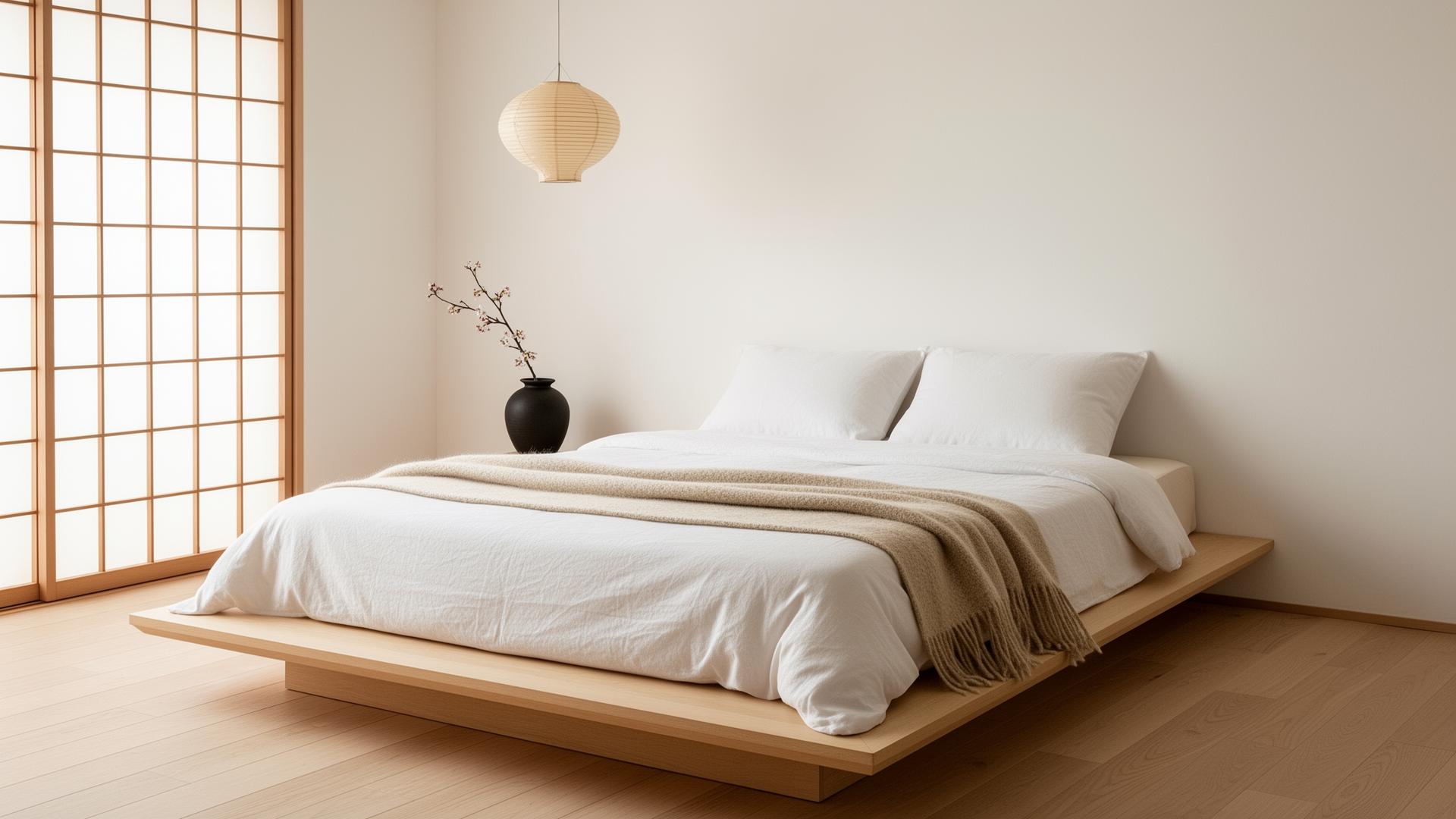
A textbook Japandi bedroom: low oak bed, linen bedding, paper pendant, one branch in a black vase.
Japandi has quietly outlasted every other interior trend of the last five years because it solves a real problem: pure minimalism feels cold, and pure Scandinavian design has drifted into IKEA-cluttered territory. Japandi keeps the discipline of Japanese aesthetics and the warmth of Nordic textiles — the result is a room that looks expensive but is built almost entirely from natural, attainable materials.
The Six Rules of a True Japandi Room
- Low and horizontal. Furniture sits close to the floor — beds, benches, coffee tables. Eye-line stays low.
- Wood is the hero. Pale oak, ash, or warm walnut. Visible grain, no veneer, no laminate.
- Empty space counts. Negative space is a design element, not a missing element.
- One material per object. A wood bench, a linen pillow, a ceramic vase — never a wood-and-metal-and-glass coffee table.
- Closed storage. Visible clutter destroys the aesthetic. Skirt the room with cabinets, hide everything.
- Paper, not glass, for light. Paper pendants, linen shades, rice-paper screens. Diffused, soft, never harsh.
The Japandi Palette (Exact Paint Picks)
- Farrow & Ball Wevet (No. 273) — the warm off-white that anchors every Japandi room.
- Benjamin Moore Swiss Coffee (OC-45) — slightly warmer; reads as oatmeal in low light.
- Sherwin-Williams Accessible Beige (SW 7036) — the safe greige; pairs with oak floors.
- Farrow & Ball Mizzle (No. 266) — muted sage for an accent wall or bathroom.
- Benjamin Moore Soot (2129-20) — the inky black for a single accent (door frame, ceramic).
Keep the ceiling and trim the same color as the walls. Contrast trim reads traditional, not Japandi.
Furniture: The Six Pieces That Define the Look
- Low platform bed — light oak or walnut, no headboard or a minimal slatted one. Try IKEA Tonsta (budget), Article Nera, or Floyd.
- Paper or linen pendant lamp — Isamu Noguchi Akari, HAY Nelson Bubble, or a budget rice-paper version from Etsy.
- Slatted wood bench — at the foot of the bed or as a hallway piece. Muji and Article both make them.
- Hans Wegner Wishbone chair (or a faithful replica) — the single sculptural seat that ties Scandinavian and Japanese together.
- Low oak coffee table — round, oval, or live-edge. Visible grain, oil finish, no varnish.
- Tatami or jute rug — natural fiber, low pile, square or rectangular. Skip patterned rugs.
Lighting: Layered and Always Warm
Use 2700K bulbs everywhere. Aim for three soft light sources per room rather than one overhead. A paper pendant for ambient light, a small ceramic table lamp for task light, and either a floor lamp with a linen shade or a wall-mounted paper sconce for accent. Dimmers are non-negotiable.
Textiles: Linen, Wool, and Nothing Synthetic
Stick to washed linen (bedding, curtains), wool (throws, rugs), and cotton (cushion covers). The palette is oatmeal, cream, sand, and muted sage with a single charcoal or black accent. Quince, Brooklinen, and Coyuchi all sell Japandi-appropriate linen bedding under $250 for a full set.
The Japandi Shopping List (Bedroom Version)
- Low oak platform bed (queen)
- Washed linen duvet cover in oatmeal or white
- Wool throw blanket in cream or sand
- Two linen pillowcases + two ceramic-button cushion covers
- Round paper pendant lamp (Noguchi or Etsy replica)
- Small ceramic table lamp with linen shade
- Jute or wool rug (8x10)
- Slatted oak bench at foot of bed
- Single black ceramic vase + one branch (cherry, olive, or magnolia)
- Low wood nightstand or stool — visible grain
- Closed-storage dresser in oak or ash
- Rice-paper or linen curtains, floor length
- One framed sumi-e ink print or wabi-sabi photograph
- Single olive tree or snake plant in a stone planter
- Linen laundry basket (no plastic visible anywhere)
- One handmade ceramic cup or vessel on the dresser
Common Japandi Mistakes
- Too much black. One inky accent per room — not a black bed frame plus a black lamp plus black hardware.
- Bamboo overload. A little is fine; a wall of bamboo reads as spa, not Japandi.
- Mass-market "Japandi" furniture. If it has a glossy finish or metal legs, it's not Japandi.
- Plant clusters. One sculptural plant beats a shelf of small pots every time.
- Visible cables and clutter. Closed storage is the entire game.
How Japandi Compares to Related Styles
Compared to dark academia, Japandi is the inverse — light where dark academia is moody, sparse where it's layered, modern where it's antique. Both styles rely on natural materials and warm light; only the palette and density differ. Some homes pair them by room: a Japandi bedroom and a dark academia study.
Frequently Asked Questions
What is Japandi style?
Japandi is a hybrid interior design style that combines Japanese wabi-sabi (the beauty of imperfection, natural materials, and emptiness) with Scandinavian hygge (warmth, functionality, and light woods). The result is a calm, minimalist space built around natural materials — light oak, linen, paper, ceramic, and stone — in a soft neutral palette. It strips Scandinavian design of clutter and warms Japanese minimalism with cozier textiles.
What colors define a Japandi room?
The Japandi palette is built on warm off-whites, oatmeal, soft greige, black, and the natural tones of pale wood. Accents are limited: muted sage green, terracotta, charcoal, or a single inky black. Avoid pure white (too cold), gray (too modern), and bright color (breaks the calm). The whole room should look like driftwood, linen, and a single black ceramic vase.
What furniture is essential for Japandi?
Low-profile, light wood furniture is core. The signature pieces are a low platform bed, a low slatted bench or media console, a round paper or linen pendant lamp, a single Windsor or Hans Wegner-style wood chair, and a low coffee table in oak or walnut. Skirt the room with closed storage so surfaces stay empty. Every piece should be solid wood or natural fiber — no laminates, no chrome, no glass.
Is Japandi the same as minimalism?
No. Pure minimalism removes everything; Japandi keeps the textures that make a room feel warm and human — handwoven baskets, raw linen throws, slightly imperfect ceramics, visible wood grain. The rule is fewer objects, but every object is tactile and slightly imperfect. A Japandi room should feel breathable, not empty.
Does Japandi work in small spaces and apartments?
Japandi is ideal for small apartments. Low furniture makes ceilings feel taller, the neutral palette expands the visual space, and the closed-storage discipline keeps clutter invisible. Stick to one piece of statement furniture per room (a paper pendant, a low bed, a wood bench) and let the empty wall space do the heavy lifting.
What plants suit a Japandi interior?
Sculptural, sparse plants only. A single olive tree, a Japanese maple bonsai, a snake plant, a fiddle leaf fig, or a branch of cherry blossom in a black ceramic vase. Avoid trailing vines, dense ferns, or grouped collections of small succulents — they read as Scandinavian-boho or millennial, not Japandi.