
Patio Ideas: 24 Designs for Outdoor Rooms That Get Used
The best patio ideas treat the space as a room, not an afterthought. This guide covers layout, furniture, flooring, shade, lighting, privacy, and plants — with specific picks, prices, and a $500 and $2,000 makeover plan.
Updated May 2026 · 13 min read
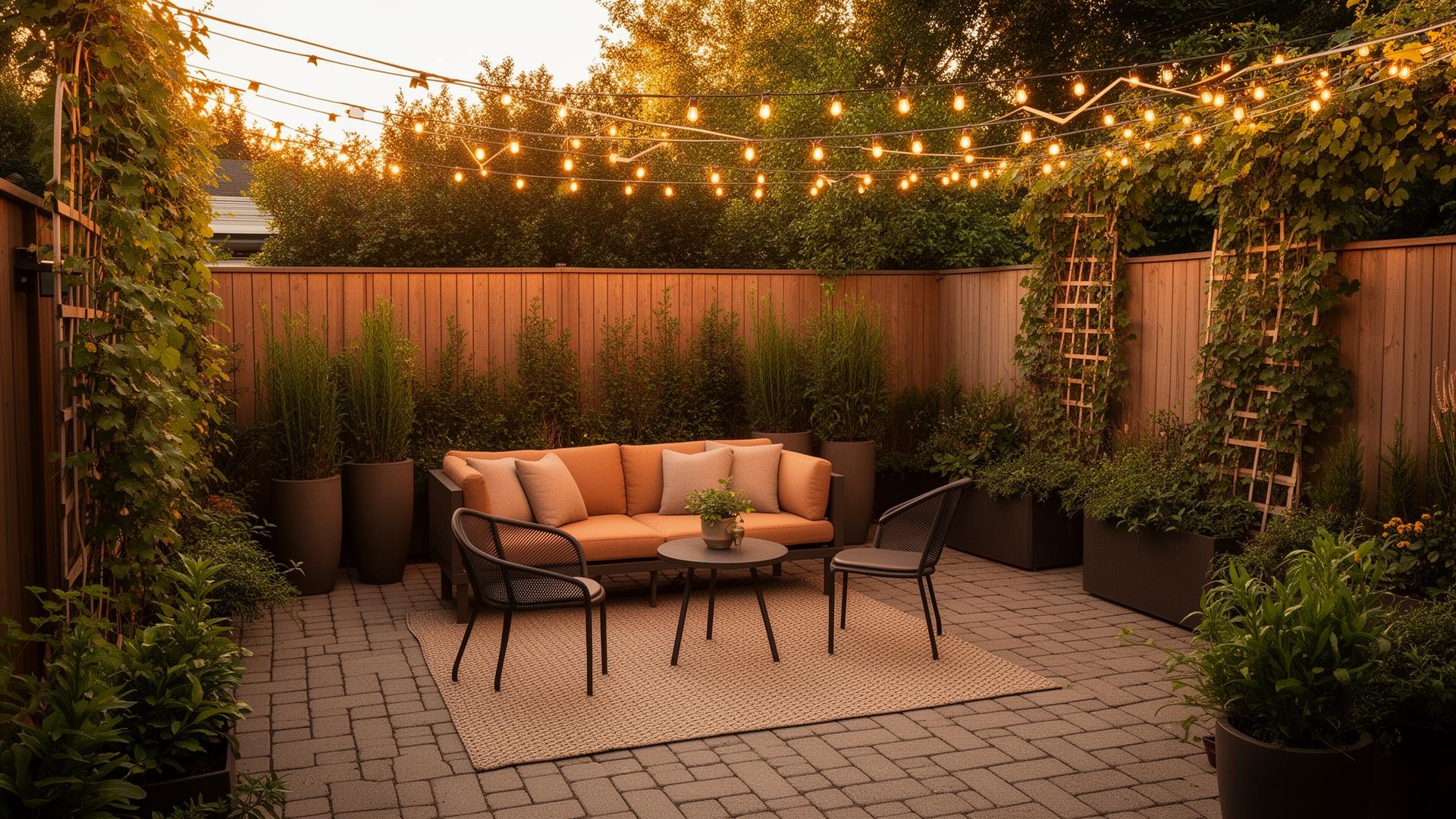
A small patio designed as an outdoor room — rug, seating, lighting, and vertical greenery.
Most patios are underused because they lack the four elements that make indoor rooms comfortable: a defined floor, a ceiling or shade structure, walls or privacy, and furniture scaled to the space. The moment you add those four things, a patio stops being a concrete slab behind the house and becomes the most-used room in the home.
This guide is organized by the element you're solving: layout, flooring, furniture, shade, privacy, lighting, and plants. Each section includes specific product types, price ranges, and the mistakes that waste money.
1. Layout: The Outdoor Room Formula
A patio works when it functions as a room. That means a floor, a ceiling, walls, and furniture — not just a table and chairs dropped on concrete.
- The floor: An outdoor rug (8×10 for a 10×12 patio) or pavers in a warm tone. The rug or paver pattern defines the "room" and separates it from lawn or garden.
- The ceiling: A pergola, shade sail, umbrella, or string-light canopy. The ceiling creates intimacy and makes the space feel enclosed, not exposed.
- The walls: Privacy screens, tall planters, trellises with vines, or outdoor curtains. Even one wall of greenery changes how the space feels.
- The furniture: A seating zone (loveseat or two chairs) and a dining zone (bistro table or bar). Two zones let the patio serve breakfast and dinner.
The rule for small patios: keep the furniture within 18 inches of the rug edges. If the rug is 8×10, the sofa and chairs should sit almost on the edge. This maximizes the usable floor and makes the patio feel larger.
2. Flooring: The Surface That Sets the Tone
Patio flooring is the most expensive decision and the hardest to change later. Choose based on your existing surface, climate, and how long you plan to stay.
- Painted or stained concrete. Best for existing concrete slabs. Clean, etch, and paint with Behr Premium Porch & Patio in warm gray or soft sage. Add a stencil for texture. Cost: ~$40 for 200 sq ft. Lasts 2–3 years before re-coat.
- Interlocking deck tiles. Snap wood or composite tiles over concrete, dirt, or grass. No tools. IKEA Runnen, NewTechWood, and Kontiki are popular. Cost: $3–$6 per sq ft. Can be lifted and re-laid if you move.
- Pavers or flagstone. Permeable, classic, and repairable. Set in sand or mortar over a compacted base. Cost: $8–$15 per sq ft installed, $5–$8 DIY. Best for warm climates — pavers stay cooler than concrete.
- Pea gravel with stepping stones. Soft underfoot, great drainage, and the cheapest hard surface. Lay weed barrier, edge with steel, fill with 2 inches of pea gravel, and set large flagstones as stepping stones. Cost: $3–$5 per sq ft. Not ideal for high heels or wheeled grills.
- Composite decking. Low-maintenance, splinter-free, and available in wood-look tones. Requires a frame or pedestal system over concrete. Cost: $12–$20 per sq ft. Best for elevated or rooftop patios.
The mistake to avoid: Dark-colored surfaces in full sun. Dark concrete stain or black deck tiles can reach 140°F in summer sun — barefoot-unfriendly and fade fast. Choose light gray, warm tan, or soft sage.
3. Furniture: Scale and Material
Patio furniture has two jobs: withstand weather and fit the space. The best pieces do both without looking like they came from a hotel pool deck.
- Loveseat or two-armchair set. 48–58 inches wide, under 30 inches deep. Open-frame metal legs or rattan make the patio feel larger because you see floor beneath. Sources: Article, Outer, West Elm, Target Project 62.
- Bistro table. 24–30 inches round or square, with two foldable chairs. Fermob makes the classic French bistro set in 24 colors; IKEA sells a similar set for under $200.
- Storage bench or outdoor cabinet. Hides cushions, garden tools, and outdoor dishes so the patio doesn't look like a storage unit. Keter and Suncast make weatherproof resin versions that look like wood.
- Nesting side tables. Two or three tables that stack into one footprint. Essential when every square foot matters. Sources: Article, CB2, Wayfair.
- Bar-height table. For tiny patios, a 40-inch bar table with two stools uses less floor space than a dining table and chairs because stools tuck underneath.
- Fold-down wall table. Mounts to a wall or railing, folds flat when not needed. The IKEA Norberg ($40) or custom cedar versions on Etsy. Perfect for balconies and the narrowest patios.
Material guide: Powder-coated aluminum is lightweight, rustproof, and modern. Teak weathers to silver-gray and lasts 20+ years with oil. All-weather wicker (HDPE resin) looks warm and handles rain but needs a cover in snow. Iron is heavy and classic but rusts without annual touch-up.
4. Shade: The Ceiling That Makes a Patio Usable
A patio without shade is a patio you don't use from 11 AM to 5 PM. The right shade structure turns the hottest hours into the most comfortable ones.
- Retractable shade sail. A triangle or rectangle of UV-blocking fabric anchored to three or four points (house wall, fence post, dedicated post). Adjust tension for more or less coverage. Cost: $80–$200. Best for flexibility — remove in winter for sun.
- Cantilever umbrella. A weighted-base umbrella with an offset pole so no pole blocks the table. Tilts and rotates to track the sun. Cost: $150–$400. Best for dining areas.
- Pergola with canopy or fabric panels. A wood or aluminum frame with a retractable fabric roof or fixed slats. Slatted pergolas filter light; fabric panels block rain and sun. Cost: $800–$2,500. Best for permanent shade with style.
- Outdoor curtains + steel cable. Hang Sunbrella or outdoor linen panels on a cable between two posts. Draw them for privacy and sun block; open them for breeze and view. Cost: $80–$150. Best for softness and flexibility.
- Bamboo or reed shade screen. Roll-up bamboo blinds mounted on a fence, railing, or pergola side. Block low-angle morning or afternoon sun for under $40. Best for budget shade.
5. Privacy: Vertical Layers, Not Solid Walls
A patio without privacy feels like a stage. The goal is screening that reads as design, not defense — layers that block sightlines without making the space feel boxed in.
- Tall planters with bamboo or grasses. Clumping bamboo in 24-inch planters grows 8–12 feet in one season and creates a green screen. Tall grasses (feather reed, pampas) soften the edge and move in wind. Cost: ~$60 per planter + plant.
- Slatted privacy screens. Cedar or acacia slat panels, 6 feet tall, spaced 1 inch apart. They filter views and light without blocking air. Cost: $120–$180 per panel.
- Climbing vines on wire trellises. Install galvanized steel cable or wire mesh 6–8 inches off a fence or wall, and train jasmine, clematis, or climbing hydrangea. Year two, a flowering green wall. Cost: ~$40 for hardware.
- Outdoor curtains. Hang Sunbrella panels on a steel cable between posts. Draw open for parties, closed for privacy. Cost: ~$80 total.
- Living wall panel. A vertical planter filled with ferns, pothos, and succulents mounted on a fence or wall. Instant greenery and screening. Cost: $100–$250.
6. Lighting: Three Layers
The best patio lighting uses three layers: ambient (overall glow), task (dining and reading), and accent (plants and architecture). Most patios only have one layer — usually a single overhead fixture — and feel flat at night.
- Ambient: string lights. A 48-foot strand of Edison bulbs hung in a zigzag or canopy pattern 8–10 feet high. Use galvanized steel cable as a support wire so sagging doesn't pull hooks out. Cost: $25–$40. The highest-impact dollar you can spend.
- Task: table lanterns. Two or three battery-operated candles in glass hurricanes on the dining table or side tables. Timer-set so they turn on at dusk. Cost: $15–$30 each.
- Accent: solar uplights. One or two solar spotlights at the base of a tall planter, tree, or sculptural plant. Creates shadow and depth on the fence or wall. Cost: $20–$40 each.
- Path: solar step or path lights. Line the perimeter or the path from door to seating. Masonry-mounted or weighted base lights stay upright. Avoid cheap spike versions. Cost: $30–$50 for a set of 6.
7. Plants: Containers and Verticals
Patio plants should live in containers and grow up, not out. Floor space is too precious for ground beds.
- Vertical climbers: Jasmine, clematis, climbing hydrangea, and Confederate jasmine. Plant in 16-inch containers at the base of a trellis or cable system. They cover vertical surfaces without eating floor space.
- Tall, narrow evergreens: Dwarf Italian cypress (columnar, 3–4 feet), sky pencil holly, and dwarf Alberta spruce. Block sightlines without eating width.
- Ornamental grasses: Fountain grass, feather reed grass, and Japanese forest grass. They catch light, move in wind, and need almost no care.
- Herb ladder or wall: A leaning ladder with 4–6 pots of basil, rosemary, thyme, and mint. Functional, fragrant, zero floor space.
- Statement container trees: One dwarf Japanese maple, olive tree in a pot, or citrus (Meyer lemon, kumquat). One statement tree beats ten small plants.
- Hanging baskets: Trailing pothos, ferns, or petunias under a pergola or eave. They add color at eye level without using floor space.
Avoid: running bamboo (escapes), English ivy (eats fences), mint in-ground (colonizes), and anything labeled "aggressive spreader." Keep all aggressive plants in containers.
8. The $500 Patio Makeover
If you have one weekend and $500, here's the spending plan that delivers the most transformation:
- $150 — Outdoor rug (8×10, Ruggable or Target)
- $100 — String lights + galvanized support cable
- $80 — Two large planters + potting soil
- $50 — Outdoor pillows and a throw (Sunbrella)
- $40 — Bamboo or reed shade screen for sun block
- $30 — Solar path lights (set of 6)
- $30 — Paint for concrete refresh
- $20 — Outdoor curtains or fabric panels
- Total: $500
9. The $2,000 Patio Makeover
With a bigger budget, replace the rug-and-lights foundation with real furniture and structure:
- $600 — Compact loveseat or two-chair set (Outer, Article, or West Elm)
- $250 — Bistro table + two folding chairs
- $200 — Storage bench or outdoor cabinet
- $180 — Slatted privacy screen (6 ft × 4 ft)
- $150 — 8×10 outdoor rug
- $100 — String lights + professional-style support
- $100 — Three large planters + mature plants
- $80 — Shade sail or cantilever umbrella
- $80 — Outdoor cushions and textiles
- $60 — Solar uplights and path lights
- $100 — Paint, gravel, or deck tile surface refresh
- Total: ~$1,900
10. Common Patio Mistakes
- Furniture too big. A full-size sofa on a 10×12 patio feels like a storage unit. Measure depth, not just width — a 36-inch-deep sofa needs 30 inches of walk space behind it.
- No shade plan. A patio with no umbrella, sail, or pergola is unusable from 11 AM to 5 PM in summer. Shade is not optional.
- Dark flooring in full sun. Dark concrete stain or black tiles hit 140°F. Light gray, tan, or sage stay cool and fade slower.
- Scattered small pieces. Ten tiny pots and three side tables read as clutter. One big planter and one bold furniture piece read as design.
- Forgetting storage. Without a bench, cabinet, or deck box, cushions and tools live on the furniture and the patio always looks messy.
- No lighting layers. One overhead fixture makes a patio feel like a parking lot at night. String lights + table lanterns + one uplight create depth and warmth.
- Planting spreaders in-ground. Mint, running bamboo, and English ivy will escape their bed and colonize the patio within a season.
11. Quick Ideas by Patio Type
- Tiny balcony (30–80 sq ft): Wall-mounted fold-down table, two folding chairs, one large potted tree, string lights in a zigzag, outdoor rug. Treat it as a café terrace.
- Small concrete patio (100–150 sq ft): Loveseat + bistro table on a rug, privacy screen or tall planters, herb ladder, string light canopy. The three-zone triangle works here.
- Townhome patio (150–250 sq ft): Full seating set + dining area, pergola with retractable canopy, storage bench, climbing vines on trellis. Room for two zones.
- Rooftop patio: Composite deck tiles over membrane, weighted-base cantilever umbrella, lightweight aluminum furniture, wind-resistant grasses and succulents. Avoid heavy planters that exceed load limits.
- Shaded patio (tree cover): Ferns, hostas, astilbe, and Japanese painted fern. Skip the sun-loving plants. Warm lighting compensates for lost sun. Moss or gravel underfoot instead of struggling grass.
- Full-sun patio (6+ hours): Lavender, rosemary, ornamental grasses, succulents. Add a shade sail or umbrella for seating relief. Light-colored flooring is essential.
Frequently Asked Questions
How do I make a small patio look bigger?
Use four visual tricks: (1) one large outdoor rug instead of several small ones — a single 8×10 rug on a 10×12 patio makes the space feel like a designed room rather than a concrete slab; (2) furniture with open frames (thin metal legs, rattan) so you see floor beneath it; (3) a vertical element like a tall planter, trellis, or hanging light to draw the eye up; (4) a mirror on a fence or wall to reflect greenery and double perceived depth. Avoid dark colors and heavy materials — they visually shrink the space.
What is the best flooring for a patio?
The best patio flooring depends on your surface and budget. For existing concrete: paint or stain with Behr Premium Porch & Patio paint ($40 for 200 sq ft). For dirt or grass: interlocking deck tiles like IKEA Runnen snap together without tools ($3–$6 per sq ft). For a permanent upgrade: poured concrete or pavers ($8–$15 per sq ft installed). For a soft, budget path: pea gravel with stepping stones ($3–$5 per sq ft). Composite decking is low-maintenance and splinter-free but costs $12–$20 per sq ft. The rule: your flooring should match your climate — concrete and tile hold heat in full sun; wood and composite stay cooler underfoot.
How do I add shade to a patio without a roof?
The best no-roof shade options are: a retractable shade sail ($80–$200) anchored to three points for adjustable coverage; a cantilever umbrella ($150–$400) with a weighted base that tilts and rotates; a pergola with a retractable canopy or fabric panels ($800–$2,500) that lets you open the roof for sun or close it for shade; and outdoor curtains on a steel cable ($80–$150) that block low-angle sun and add privacy. For a tiny budget: a bamboo or reed shade screen mounted on the railing or fence blocks direct sun for under $40.
What furniture works best on a small patio?
Scale and flexibility matter most. The best small-patio furniture is: a loveseat (48–58 inches wide) or two armchairs instead of a full sofa; a 24–30 inch bistro table with foldable chairs; nesting side tables that stack into one footprint; a storage bench that doubles as seating and hides cushions; and a fold-down wall-mounted table for the tiniest spaces. Look for pieces under 30 inches deep with open frames (thin legs, no bulky skirts) so you see floor beneath them. Materials: powder-coated aluminum (lightweight, rustproof), teak (ages beautifully), and all-weather wicker (Target, Article, Outer).
How do I add privacy to a patio without building a wall?
Use vertical layers instead of solid walls. The best patio privacy solutions are: tall planters with clumping bamboo or sky pencil holly (grows 8–12 feet in one season); slatted wood or metal privacy screens (filter light and views without blocking air); climbing vines on wire trellises or cable systems (jasmine, clematis, climbing hydrangea); outdoor curtains on a steel cable between two posts (draw open for entertaining, closed for privacy); and a living wall of ferns, pothos, or succulents in a vertical planter panel. Each layer adds 6–18 inches of visual screening without making the patio feel boxed in.
How much does it cost to redo a patio?
A patio redo ranges from $300 DIY to $15,000+ professionally installed. A $500 DIY refresh covers paint, an outdoor rug, string lights, two large planters, and new cushions. A $2,000 update adds real furniture (loveseat + bistro set), a storage bench, a privacy screen, and a shade sail. A $5,000–$8,000 mid-range redo includes poured concrete or pavers, a pergola, and quality furniture. A $10,000–$15,000 professional install covers stamped concrete or composite decking, a custom pergola with canopy, built-in seating, and landscape lighting. The highest-ROI spend is always flooring and lighting — they transform the space instantly.