
Mudroom Ideas: 22 Layouts, Real Costs & Build Plans
A working mudroom is the highest-ROI 20 sq ft in the house — it keeps the rest of the home clean, organized, and on schedule. This guide is 22 layouts across every footprint, real 2026 costs, three complete build plans from $400 to $15K, and the 4-zone system that keeps it usable past month two.
Updated May 2026 · 12 min read
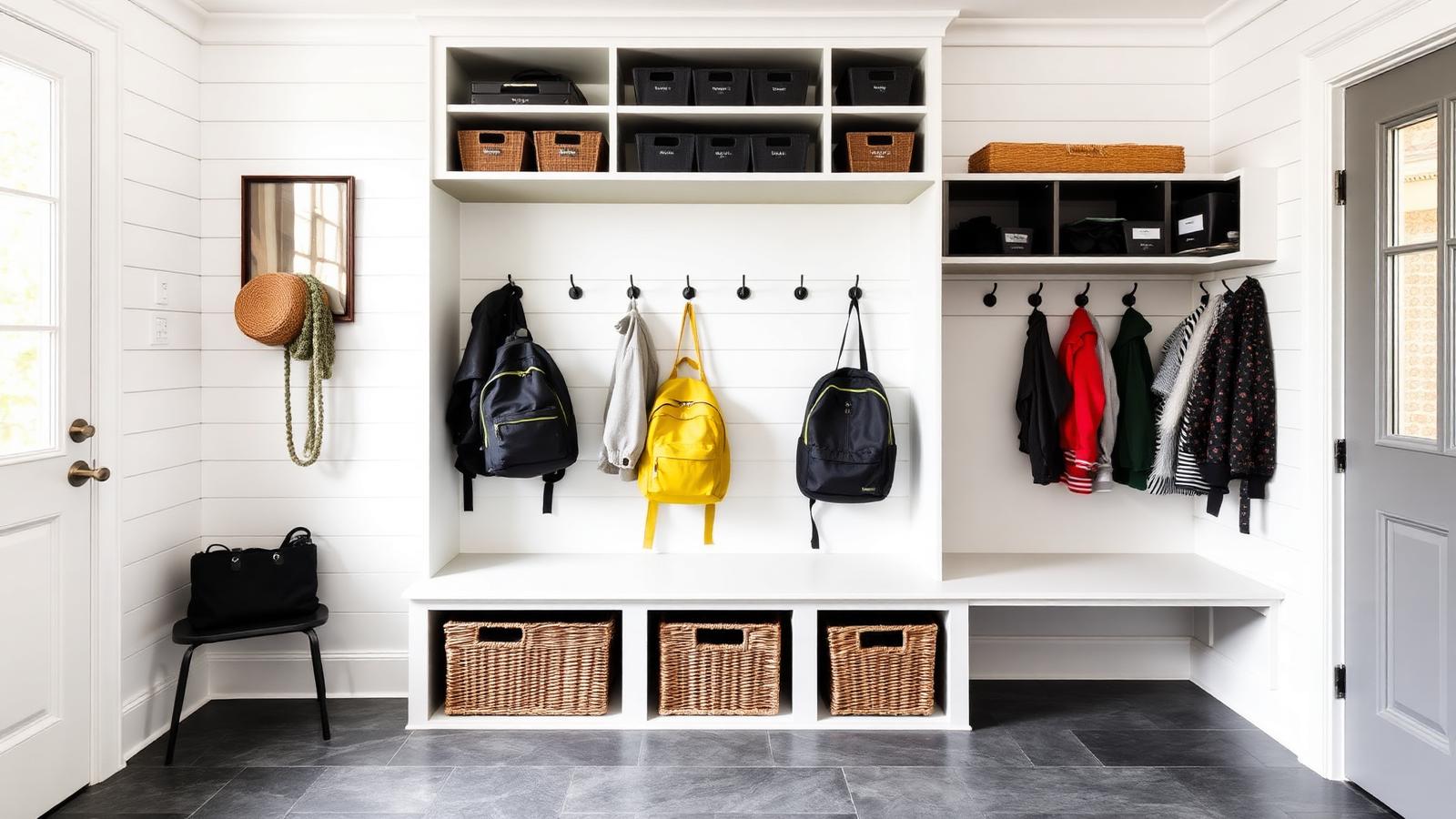
The classic American mudroom: bench, cubbies, hooks, top shelf — one column per family member, slate or porcelain floor.
The 4-Zone Mudroom System
Every mudroom that stays organized for more than a season is built around four zones:
- Drop zone (top shelf + bench top): keys, mail, today's bag.
- Hang zone (hooks + rail): coats, backpacks, dog leashes.
- Floor zone (bench cubbies + boot tray): active-rotation shoes only.
- Long-term zone (top shelf bins): off-season hats, gloves, scarves.
22 Mudroom Layouts by Footprint
Tiny (Under 20 Sq Ft)
- IKEA Trones stack + Pinnig rack. 3 Trones cabinets wall-mounted, hook rail above — under $300, 24" of wall length.
- Bench-only with under-seat baskets. 36" bench, two baskets below, 4 hooks above — fits in a 3 ft alcove.
- Closet conversion. Remove the coat closet door, add a bench seat 18" off the floor, hooks at 64".
- Wall-mounted everything. Floating bench, floating shoe shelf, floating hook rail — 0 floor footprint, easy to mop.
Small (20–40 Sq Ft)
- Bench + cubbies + hooks (the classic). 5–6 ft wall, 3 cubbies, 6 hooks, top shelf with bins.
- L-shaped corner mudroom. Bench on long wall, tall locker on short wall — fits 4 people in 32 sq ft.
- Bench with pull-out drawers. Drawers instead of open cubbies — kids drop shoes in, slide shut, mess hidden.
- Bench + tall pantry-style cabinets. Cabinets to ceiling on either side of the bench — maximum storage in small footprint.
Standard (40–80 Sq Ft)
- Full locker wall. One full-height locker per family member with bench seat, hook, top shelf, and shoe cubby.
- Bench wall + opposite cabinet wall. Bench on one side, full cabinets on the other for sports gear and seasonal storage.
- Mudroom + laundry combo. Stacked washer/dryer at one end, mudroom bench at the other — shared utility space.
- Built-in with utility sink. Adds a 24" base cabinet with sink between bench and laundry.
Generous (80+ Sq Ft)
- Locker wall + island. Center island for folding laundry and prepping bags doubles the function.
- Locker wall + dog wash station. Tile shower 24"x36" with a curtain — biggest quality-of-life upgrade for pet households.
- Mudroom-pantry hybrid. Bench wall on one side, walk-in pantry shelving on the other.
Garage & Side-Entry Mudrooms
- Garage transition wall. Bench + lockers along the wall between garage and house entry door.
- Three-season covered porch. Convert a covered porch with vinyl windows into a seasonal mudroom.
- Side-entry bump-out. 4'x6' bump-out off the side door — adds a real mudroom to homes that don't have one.
Style Variations
- Farmhouse: Shiplap walls, black iron hooks, wood bench, slate floor.
- Modern: Flat-front lockers, integrated LED lighting, large-format porcelain floor.
- Traditional: Beadboard wainscoting, brass hooks, painted MDF bench, herringbone tile.
- Coastal: Whitewashed wood, woven seagrass baskets, hooks in brushed nickel.
Three Complete Build Plans
$400–$900: IKEA Hack Mudroom
- 3x IKEA Trones cabinets — $120
- IKEA Pinnig hook rack — $50
- IKEA Kallax 2x2 bench-height — $80
- 4x woven storage bins — $80
- Washable runner — $60
- Paint + finishing — $80
$1,500–$3,500: Freestanding Mudroom
- Pre-built storage bench with cubbies (Pottery Barn, Wayfair) — $700–$1,200
- Hall tree with mirror — $400
- Hook rail + 6 hooks — $80
- Floating shelf above bench — $80
- Boot tray + 4 labeled baskets — $150
- Slate or porcelain runner area — optional $300
$6,000–$15,000: Full Built-In
- Custom built-in bench + lockers (carpentry) — $3,500–$8,000
- Shiplap or beadboard paneling — $800–$1,500
- Porcelain or slate tile floor installed — $1,500–$2,500
- Hardwired sconces (pair) — $400 + electrician $300
- Bench cushion + custom basket fit — $400
- Optional utility sink + plumbing — $1,500–$3,000
The Mudroom Mistakes That Cost the Most
- Too many open cubbies. Without baskets, open cubbies look messy within a week. Limit to 1 per person.
- Skipping the boot tray. Without drainage or a tray, snowmelt destroys floors and warps wood benches.
- Wrong floor. Hardwood or carpet in a mudroom is a 2-year mistake. Tile is the only correct answer.
- No labels on bins. Bins without labels devolve into junk drawers within a month.
- Mounting hooks into drywall only. Coats + backpacks weigh 15+ lbs — hooks must hit studs or use heavy-duty toggle anchors.
Frequently Asked Questions
How much does a mudroom cost in 2026?
A budget IKEA-based mudroom runs $400–$900 (Trones cabinets, Pinnig hook rail, basket bins). A mid-range freestanding mudroom with quality bench and lockers runs $1,500–$3,500. A full custom built-in with paneling, bench, lockers, tile floor, and hardwired sconces runs $6,000–$15,000. Adding plumbing for a utility sink adds $1,200–$2,500.
What is the minimum size for a functional mudroom?
A working mudroom needs at least 5 feet of wall length and 4 feet of depth (20 sq ft). That fits a 4–5 ft bench with 2–3 cubbies, hooks above, and a top shelf — plus enough floor space to bend down and remove boots. For a 4-person family, 7 ft of wall and 5 ft of depth (35 sq ft) is the comfortable minimum.
What's the best flooring for a mudroom?
Porcelain tile is the gold standard — waterproof, scratch-proof, easy to clean, and handles snow melt. Slate or large-format gray porcelain hide dirt between mopping. Luxury vinyl plank (LVP) is a budget alternative at $3–$7/sq ft installed but can show wear from grit. Avoid hardwood, carpet, and natural stone (slippery and stains from salt).
How deep should a mudroom bench be?
16–18 inches deep is the comfort zone — deep enough to sit on while pulling off boots, shallow enough not to eat the room. Seat height: 17–19 inches off the floor. Cubby height below the bench: 12–14 inches (fits adult shoes and boots). Hook height above the bench: 60–66 inches for adults, 40–48 for kids.
Lockers vs open cubbies — which is better?
Lockers (closed doors) hide mess and look tidier from across the room, but families use them less because they require an extra step. Open cubbies get used more, get messier faster, and benefit from labeled baskets to contain the chaos. Hybrid: open cubbies below, closed cabinets above — fastest to use, hides what you don't want to see.
Can I add a mudroom if I don't have one?
Yes — three common conversions: (1) Carve 4–6 ft off a long entry hallway for a bench-and-hook wall. (2) Convert a coat closet into an open mudroom nook by removing the door and adding bench + cubbies. (3) Build out a corner of the garage with bench, hooks, and shoe storage — the 'transition mudroom.' All three run $600–$3,000 depending on whether you DIY.
Do I need a utility sink in the mudroom?
Only if you're already running plumbing nearby (laundry room shared wall, kitchen back wall) — adding net-new plumbing for a sink alone runs $1,500–$3,000. If yes: a deep cast-iron utility sink is invaluable for dog baths, muddy boots, and washing garden produce. Pair with a pull-down sprayer faucet.