
Entryway Ideas: 26 Designs for Small, Narrow & No-Foyer Homes
The entryway is the room that solves — or creates — the daily pile-up of shoes, bags, mail, and keys. This guide covers 26 designs across every floor plan (narrow, no-foyer, open-concept, classic), the four elements every entry needs, and three complete build plans from $150 to $2,500.
Updated May 2026 · 11 min read
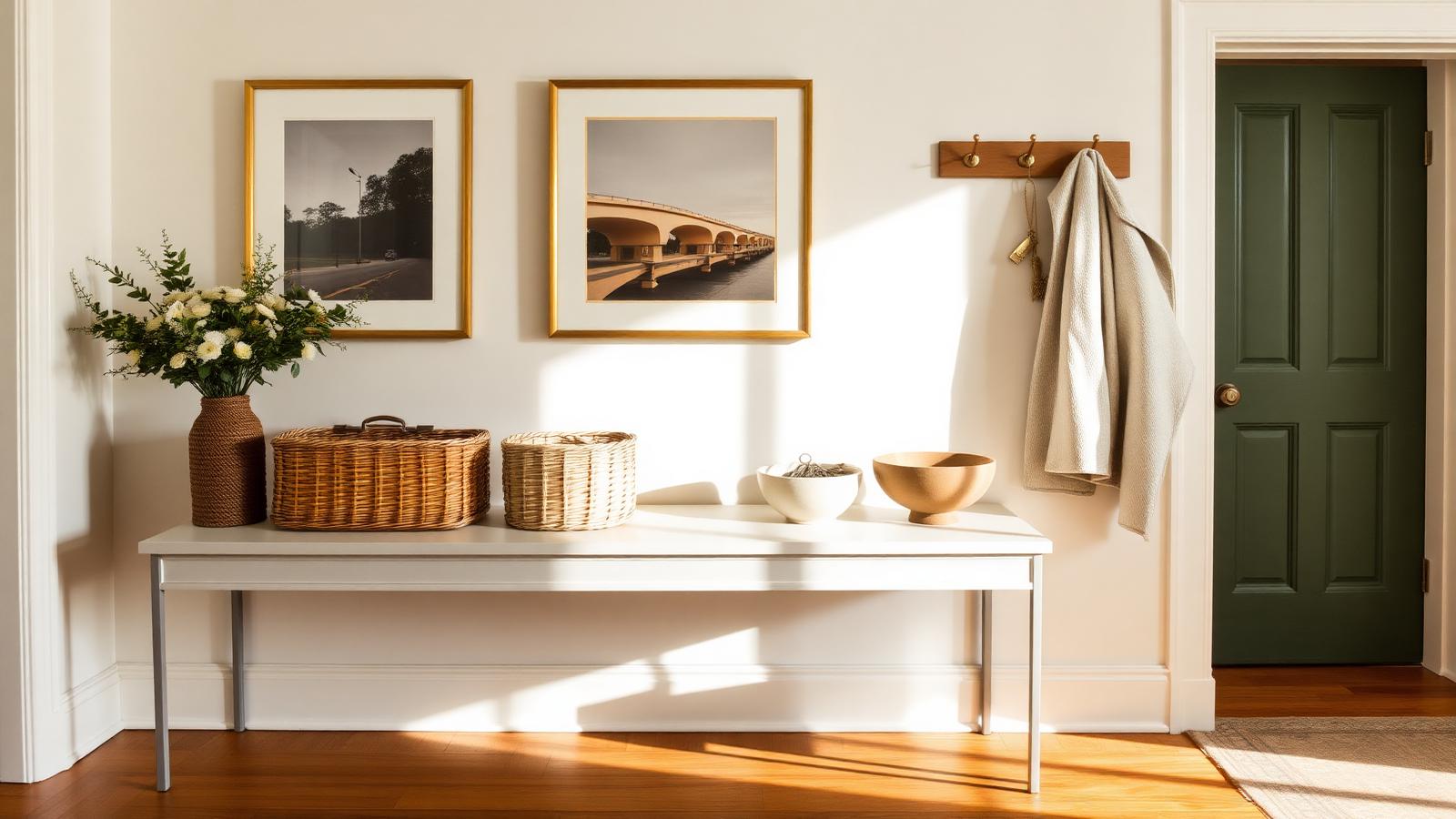
Console + baskets + hooks + mirror — the four-element kit that works in any entry.
The Four-Element Entryway Kit
Every functional entryway, regardless of size, has the same four elements: a drop surface (console, shelf, or bench top), vertical storage (hooks or a coat rack), a floor catch (basket, tray, or bench cubby), and a visual anchor (mirror, art, or sconce). Skip any one and the pile-up returns within a week.
26 Entryway Designs by Floor Plan
No-Foyer (Door Opens Into Living Room)
- Floating shelf + hook rail. 30" floating shelf above a row of 4 hooks defines the zone without a floor footprint.
- Slim console behind the sofa. If the sofa backs to the door, a 10" deep console with baskets below doubles as entry and sofa table.
- Folding wall bench. Wall-mounted bench folds flat when not in use — useful for putting shoes on without blocking the path.
- Tall narrow shoe cabinet (IKEA Bissa). 12" deep, 30" wide, doubles as drop surface and full shoe storage.
- Open coat rack with bench. Freestanding pole with bench base — moves with you, no install.
Narrow Entryway (Under 5 Feet Wide)
- Narrow console (8–10" deep). West Elm Mid-Century, IKEA Lack — leaves 36" walking path.
- Wall-mounted leaner. Console anchored to studs, no front legs — gain 4" of floor space.
- Bench-only entry. 14" deep bench with cubbies underneath, hooks above — replaces console entirely.
- Vertical paneling with built-in hooks. 4" deep wall paneling with integrated hook strip — looks built-in, low footprint.
- Mirror-front cabinet. Slim shoe cabinet with full-length mirror door — does triple duty.
Classic Foyer (6+ Feet Wide)
- Center pedestal table. Round 36" table with a single statement vase — the magazine entry.
- Bench under window. Upholstered bench with toss pillows under the foyer window.
- Built-in lockers. Floor-to-ceiling locker uprights, one per family member.
- Console + gallery wall. 60" console with a 3x3 grid of framed prints above.
- Statement chandelier. Hang 6.5–7' off the floor as the visual anchor.
Mudroom-Style Drop Zone
- Built-in bench + cubbies + hooks. The classic — one cubby per person, hooks above, top shelf for baskets. See our mudroom guide.
- IKEA Trones stack + Pinnig rack. Renter-friendly mudroom for under $300.
- Slate-tile floor with drainage. For snow / rain regions — boots dry without ruining the floor.
Apartment & Rental Entries
- Command-strip hook rail. 24" wood rail with 4 hooks, removable — survives most leases.
- Freestanding coat tree. Wood or brass, no install — moves with you.
- Bookshelf turned sideways. Low 4-cubby bookshelf (Kallax 2x2) with baskets — doubles as bench.
- Tension-rod curtain divider. Marks the entry zone in studio apartments.
Family-Friendly & Kid-Height
- Two-row hook system. Adult hooks at 64", kid hooks at 42" — kids hang their own coats.
- Color-coded basket per kid. Toss-in for hats, gloves, library books.
- Bench drawer with shoe sort. One drawer per kid — no decisions, just throw in.
- Chalkboard panel above bench. Daily reminders, school lunches, who's getting picked up.
Three Complete Build Plans
$150–$400: Renter Refresh
- Paint accent wall (1 gallon) — $50
- IKEA Hemnes mirror — $80
- 4-hook brass rail — $35
- Washable rug 2x3 — $45
- Two woven baskets — $60
- Slim console (IKEA Lack or Target) — $80
$500–$1,500: Mid-Range Glow-Up
- Quality console (West Elm or Crate & Barrel) — $450
- Upholstered bench — $350
- Wired sconce or hardwired pendant — $150 + electrician $200
- Framed gallery wall (4–6 prints) — $200
- Larger washable rug or runner — $150
$2,500–$8,000: Built-In Foyer
- Custom built-in bench + lockers — $3,500–$6,000
- Wainscoting or vertical paneling — $800–$1,500
- Tile flooring (porcelain) — $8–$15/sq ft installed
- Hardwired sconces (pair) — $400 + electrician
- Statement mirror or art — $300+
The Five Most Common Mistakes
- Console too deep. Anything over 12" in a narrow entry blocks the door swing.
- Hooks too high or too low. 60–66" for adults — anything else gets ignored.
- No floor catch. Without a basket or bench cubby, shoes pile in front of the door.
- Wrong rug material. Wool or cotton stains in one wet season. Use polypropylene or low-pile washable.
- Skipping the mirror. A mirror doubles light and perceived space — non-negotiable in dark or narrow entries.
Frequently Asked Questions
How do I design an entryway when I don't have a foyer?
Create a 'virtual entryway' in the first 36 inches inside the front door. The minimum kit: a narrow console or floating shelf (8–10 inches deep), three wall hooks at adult shoulder height, a 2x3 ft washable rug, and a basket on the floor for shoes. A mirror above the console doubles the perceived space. A pendant light or sconce visually marks the zone as separate from the living room. Total cost: $200–$500 from IKEA, Target, or West Elm.
What's the right width for an entryway console table?
For tight entryways under 5 feet wide, choose a console 8–12 inches deep so it doesn't block the swing of the door or the walking path. Keep at least 30 inches of clear walking space between the console and the opposite wall (36+ for a main entry). Length: 36–48 inches is standard for narrow halls. For wider foyers, scale up to 14–18 inches deep and 60+ inches long.
What is the best entryway flooring?
Porcelain tile is the gold standard — waterproof, scratch-resistant, holds up to slush, sand, and pet claws. Luxury vinyl plank (LVP) is a budget runner-up at $3–$7/sq ft installed. Hardwood works only if you commit to a substantial rug or runner and refinish every 7–10 years. Avoid carpet (stains within a season) and natural stone (slippery, stains from salt).
How high should I hang entryway hooks?
60–66 inches from the floor for adult coats, 40–48 inches for kids. If you only install one row, default to 64 inches — coats hang clean and kids can be taught to reach. Space hooks 8 inches apart minimum for thick winter coats, 6 inches for lighter jackets. Mount into studs or use heavy-duty drywall anchors rated for 25+ lbs each.
What paint color is best for a small entryway?
For small or dark entryways, a saturated 'jewel box' color (deep green, navy, terracotta, or black) actually makes the space feel intentional rather than cramped — Farrow & Ball Studio Green, Benjamin Moore Hale Navy, or Sherwin-Williams Tricorn Black are go-tos. For bright entryways, warm whites with a slight beige undertone (BM White Dove, SW Alabaster) read welcoming and don't show scuffs as fast as cool whites.
Do I need a rug in the entryway?
Yes — a washable, low-pile entry rug protects the floor and catches 80% of tracked-in dirt. Best dimensions: 2x3 ft for narrow entries, 3x5 ft for standard foyers, 4x6 ft for grand entries. Materials that survive: indoor-outdoor polypropylene, low-pile wool, or jute (avoid jute in wet climates — it absorbs water). Look for a rubber backing or use a thin non-slip pad underneath.
How much does an entryway makeover cost?
Three tiers: budget makeover $150–$400 (paint, IKEA console, hooks, rug, basket), mid-range $500–$1,500 (statement console, bench, sconce or pendant, framed art gallery, runner), and full built-in $2,500–$8,000 (custom bench, lockers or paneling, integrated lighting, hardwired sconces). Add tile flooring at $8–$15/sq ft installed if you're replacing the floor.