Kitchen Cabinet Ideas: Styles, Colors & the Four Cost Tiers
Cabinets are 30–40% of a kitchen renovation and the single decision most likely to be regretted in five years. Below — the four cost tiers honestly compared, the door styles and colors that actually age well, and the build details worth paying the upcharge for.
Updated May 2026 · 9 min read
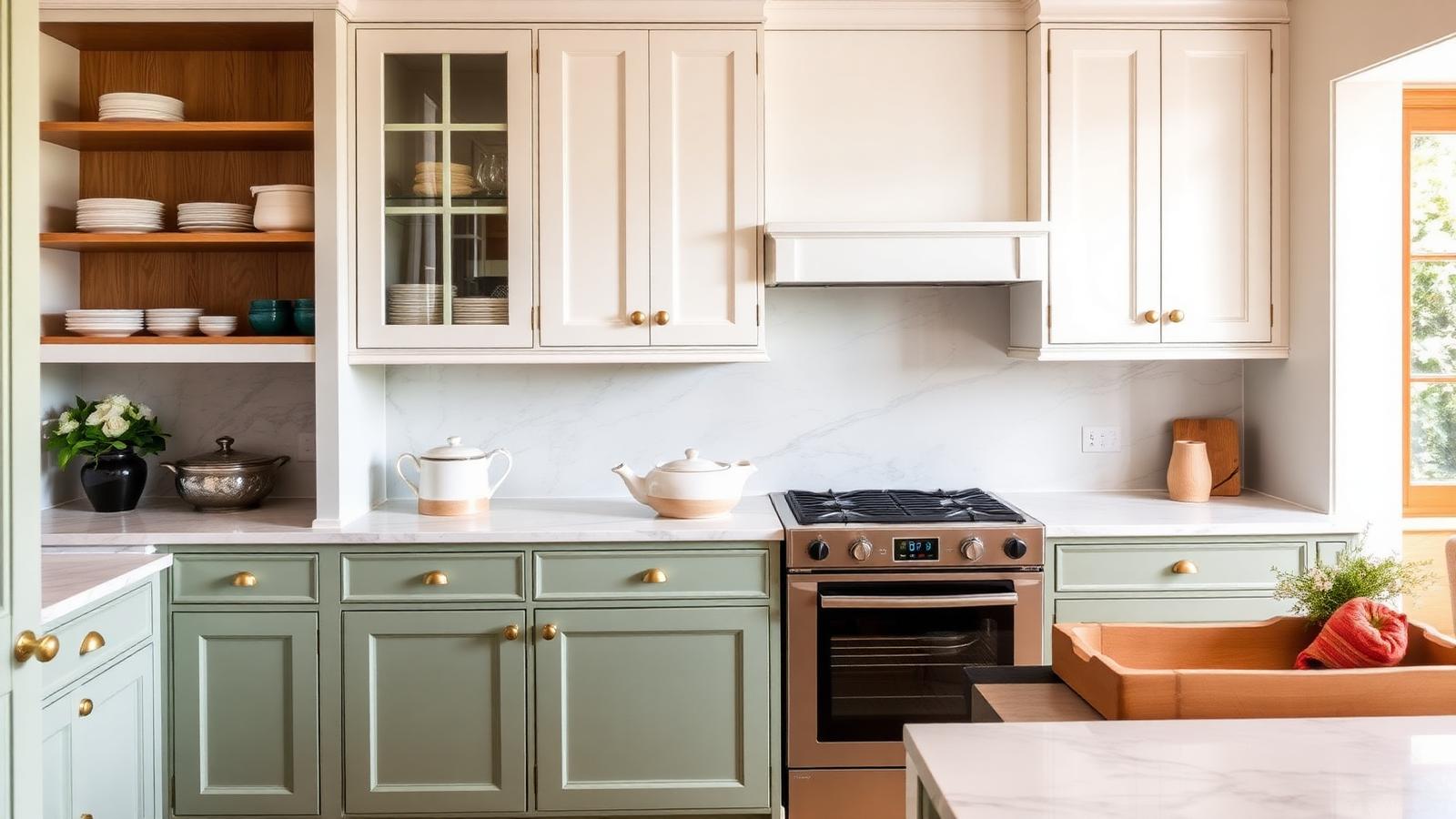
Two-tone shaker cabinets — soft sage lowers with warm white uppers, brass cup pulls, and a marble slab backsplash that ties the two finishes together.
The Four Cabinet Tiers
1. Refacing — $4,000–$12,000
Keep the existing cabinet boxes, replace doors and drawer fronts, veneer the exposed box ends to match. Same footprint, 60% of the visual change of new cabinets, half the cost. Works only if your boxes are solid wood or plywood and structurally sound. Skip if boxes are particleboard with water damage.
2. Stock — $4,000–$10,000
Pre-built in standard sizes (3" increments), available at IKEA, Home Depot, Lowe's, and online (Cabinets To Go, Cabinets.com). Plywood or particleboard box options, limited door styles, in-stock for fast delivery. IKEA Sektion is the most upgrade-friendly stock line because Semihandmade and Reform sell premium doors that fit the IKEA box system at semi-custom prices.
3. Semi-Custom — $12,000–$25,000
Pre-engineered cabinet lines with customization on size (1/8" or 1/4" increments), finish, hardware, and interior accessories. Most homeowners' best value — sourced through local kitchen showrooms (KraftMaid, Medallion, Shiloh). 6–10 week lead times. The biggest quality jump from stock — soft-close everything, dovetail drawers, plywood boxes, real wood doors.
4. Custom — $25,000–$60,000+
Built to your exact kitchen by a local cabinet shop or premium factory (Wood-Mode, Plain & Fancy, Christopher Peacock). Inset doors, painted + stained mixes, integrated appliance panels, full-overlay precision, any size or shape. 10–16 week lead times. Worth it when the kitchen has unusual angles, ceiling height, or appliance panels that semi-custom can't handle.
Door Styles, Ranked by How Well They Age
- Shaker (overlay). Flat center panel, square frame. The universal classic. Works in every style.
- Inset Shaker. Same shaker face, but door sits flush with the frame. Reads custom, lasts forever.
- Slab. Flat, no frame, no profile. Modern, Scandinavian, Japandi. Quartersawn oak slab is the most-used premium look right now.
- Beaded inset. Slim bead detail around the door. Reads traditional but tasteful — works in older homes.
- Raised panel. Center panel raised with a routed profile. Reads suburban-traditional. Dating fast in 2026.
- Cathedral / arched. Curved top profile. Reads 1990s. Avoid.
Color Choices That Won't Date
- Warm white. Benjamin Moore White Dove, Simply White, Sherwin-Williams Alabaster, Pure White. The default for small kitchens.
- Off-white / cream. Benjamin Moore Swiss Coffee, Cloud White. Works in homes with warm-toned floors and counters.
- Pale gray-green. Sherwin-Williams Sea Salt, Farrow & Ball Pigeon. Reads neutral with personality.
- Natural oak. White oak, rift-cut. The modern natural-wood look. Pairs with white and sage.
- Walnut. Premium, warm, dramatic. Best on an island only or in a large kitchen.
- Soft sage. Farrow & Ball Mizzle, Benjamin Moore Saybrook Sage. The most-used color trend in 2026 — already past peak.
The Build Details Worth the Upcharge
- Plywood boxes. Lasts 25+ years vs 10–15 for particleboard. $1,000–$2,000 upcharge on a full kitchen.
- Soft-close hinges and drawer slides. Should be standard. Walk away from any line that charges extra.
- Full-extension drawers. Replaces cabinet shelves where it makes sense — sink base, pantry, pot storage. Doubles usable storage.
- Pull-out trash + recycling. $250–$400. The single most-used pull-out in any kitchen.
- Toe-kick drawers. 2.5" tall, used for trays and platters. $200 each, two or three per kitchen.
- Under-cabinet outlets. Hidden in the cabinet molding strip — no more wall outlets in the backsplash.
- Integrated appliance panels. Dishwasher and fridge disappear into the cabinetry. Worth it in a small kitchen where appliances are visually dominant.
Hardware Pairings That Work
- Shaker + cup pulls + brass. The classic farmhouse-to-modern transition look.
- Shaker + bar pulls + polished nickel. Reads clean-modern in a warm-white kitchen.
- Slab + finger-pull edge + no hardware. Hardware-free European look. Premium, minimal, requires precision install.
- Inset shaker + small round knob + unlacquered brass. The classic English kitchen look. Ages into beautiful patina.
One finish throughout the kitchen — mixing brass and nickel reads busy. The faucet, cabinet hardware, and lighting all in the same metal.
Mistakes to Avoid
- Trendy color on perimeter cabinets. Confine color to an island. Perimeters in neutral.
- Mixed metals across hardware and fixtures. Pick one finish per kitchen.
- Open shelves everywhere. Beautiful in photos, exhausting in life. 30% maximum.
- Glass-front upper cabinets on every door. Reads 2005. Use on one or two cabinets max.
- Ornamental crown molding stack. Multi-piece stacked crown reads traditional-suburban. A single 4" cove or no molding reads custom.
- Under-mount roll-out trays instead of full drawers. Full drawers are objectively better — the upcharge is small.
Keep Reading
- Kitchen Renovation Guide — full costs, layouts, and budget plans
- The Remodel Pillar Guide — every major remodel project compared
- Japandi Style — the warm-minimal kitchen aesthetic in detail
- Grandmillennial Style — inset cabinetry, beaded detail, traditional done right
- Spice Rack Organization — the cabinet interior detail every renovation forgets
Planning the Budget Next?
Design decisions get easier once you know the numbers. These cost guides use 2026 pricing from real quotes.
- Kitchen Renovation CostsBudget tiers, ROI, and where the money actually goes.
- Electrical Panel Upgrade CostNew appliances often need more amps — here's the price.
- Contractor Vetting ChecklistThe questions that separate solid bids from bad ones.
Already holding a contractor quote? Kitchen Remodel Estimate Review — $49, back in 48 hours.
Frequently Asked Questions
What are the cabinet tiers and what do they cost?
Four tiers in 2026: (1) Refacing — keep the boxes, replace doors and veneer — $4,000–$12,000 for a 10x10 kitchen. (2) Stock — pre-built sizes, Home Depot/Lowe's/IKEA — $4,000–$10,000. (3) Semi-custom — limited customization on box sizes and finishes — $12,000–$25,000. (4) Custom — built to your kitchen by a local cabinet shop or factory like Wood-Mode — $25,000–$60,000+. The biggest jump in quality is stock → semi-custom; the biggest jump in price is semi-custom → custom.
Are IKEA kitchen cabinets worth it?
Yes, for the right project. IKEA's Sektion line has solid 25-year warranty, real plywood backs, soft-close hinges and drawers included, and a price about 40% below comparable semi-custom. The downside: door style options are limited (Semihandmade and Reform sell upgraded doors), the boxes come flat-pack and install is slow for a DIY-er, and the system is metric — toe kicks and trim work needs planning. A 10x10 IKEA kitchen with Semihandmade doors lands around $8,000–$14,000 — half a semi-custom price for similar real-world quality.
What cabinet door style ages best?
Shaker doors — flat center panel, square frame — are the safest classic in 2026. They work in traditional, modern, farmhouse, and Japandi kitchens. Slab doors (flat, no frame) read more modern and work for Scandinavian and minimalist kitchens. Skip raised panel doors (read suburban-traditional, dating fast), beadboard inserts (read coastal, dating fast), and glass mullion doors on every upper (reads early-2000s). Inset shaker — where the door sits flush with the frame rather than overlaying — is the premium choice and reads custom even at semi-custom prices.
What's the best cabinet color for a small kitchen?
Warm white (Benjamin Moore White Dove, Sherwin-Williams Alabaster) is the safest expander — bounces light, recedes visually, and matches every counter and floor. Off-white and bone work in warm-toned kitchens. Soft sage and pale gray-green are 2026's most-used color trend and will age better than navy or forest green because they read as neutral. For small kitchens, paint the whole space one color (cabinets, walls, trim) for the most visual expansion. Skip dark cabinets unless the kitchen has at least two windows.
Two-tone cabinets — yes or no?
Yes, with a rule: keep the perimeter cabinets neutral (white, off-white, pale gray) and use color on the island only, or use a darker stain on the lowers with painted uppers. This isolates the trend to one element you can repaint or replace without redoing the whole kitchen. Avoid sage-and-walnut, navy-and-white-and-brass, and any combo where both colors are saturated — those date together and there's no rescue paint job. Single-color kitchens always age better than two-tone.
Are open shelves a good idea?
In small doses. One or two runs of open shelving — flanking a range hood, above a coffee bar — adds visual relief and works beautifully in photos. Replacing all upper cabinets with open shelves looks great on Pinterest and means living with daily dish-styling and dust. The compromise: keep 70% closed storage, use glass-front or open shelves for 30%, ideally for daily-use ceramics and glassware that actually get rotated.
What cabinet details are worth the upcharge?
In rough ROI order: (1) Soft-close hinges and drawer slides — should be standard, walk away if not included. (2) Plywood box construction — vs particleboard, $1,000–$2,000 upcharge, doubles cabinet lifespan. (3) Full-extension drawers vs roll-out trays — easier to use, no comparison. (4) Pull-out trash and recycling — $300 well spent. (5) Under-cabinet outlets in the molding strip — removes the kitchen's worst eyesore. (6) Toe-kick drawers — $400 for two extra shallow drawers. Skip the appliance garage and the spice pull-out — both date and rarely get used as planned.