
Electrical Panel Upgrade Cost (2026): The Real Numbers
Most articles on electrical panel upgrade cost quote a $1,500 to $4,000 range and leave you to figure out where you actually fall. This guide breaks pricing down by panel size, walks through the line items electricians actually charge, names the hidden costs that double quotes, and explains the IRA rebates that can knock $4,000 off the final bill.
Updated May 2026 · 10 min read
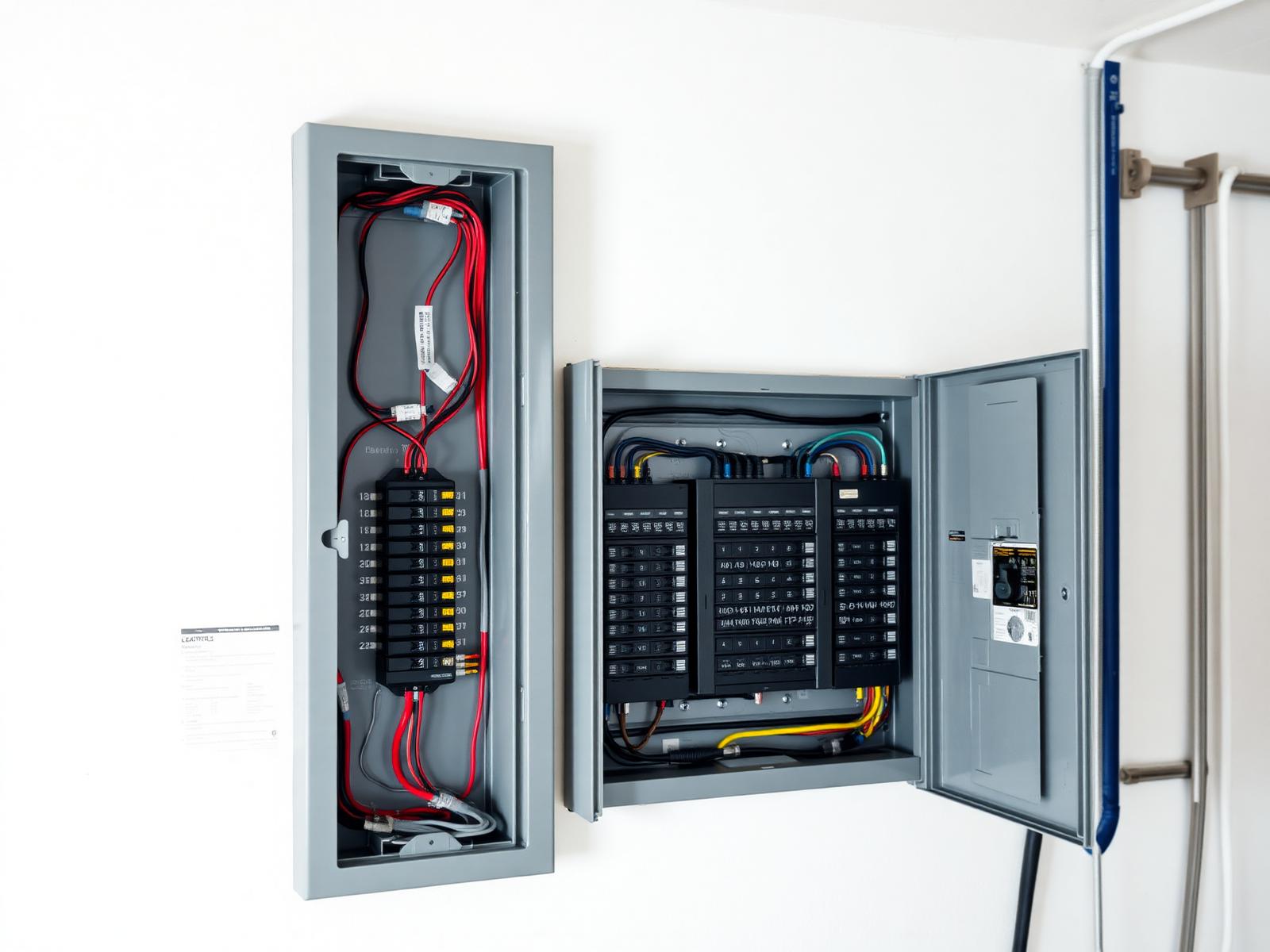
A typical 200-amp panel upgrade — the most common job in 2026 as homes electrify.
Short answer
An electrical panel upgrade costs $1,800 to $4,500 in 2026 for a standard 200-amp replacement, with the national average around $2,800. A like-for-like swap at the same amperage runs $1,200–$2,500; a 400-amp upgrade runs $3,500–$8,000. Add $100–$500 for the permit, and budget another $500–$1,500 if the service entrance cable or meter base needs replacing.
The long answer — the one that tells you whether your quote is fair — depends on six variables most contractors don't break out unless you ask.
Cost by Panel Size (2026 National Averages)
| Panel Size | Typical Cost | Best For |
|---|---|---|
| 100 amp | $1,200 – $2,500 | Small homes under 1,500 sq ft, no EV, gas heat |
| 150 amp | $1,500 – $3,200 | Mid-size homes, one electric major appliance |
| 200 amp | $1,800 – $4,500 | Most modern homes; standard for EV + heat pump |
| 320 amp | $2,800 – $6,500 | Large homes, ADUs, dual EV chargers |
| 400 amp | $3,500 – $8,000 | 5,000+ sq ft, workshop, multiple high-draw appliances |
Cost by Region: What Labor Does to the Price
Labor is 40–60% of a panel upgrade bill, and electrician hourly rates vary more than any other factor. The same 200-amp upgrade, by region:
| Region | Typical Electrician Rate | 200A Upgrade, All-In |
|---|---|---|
| West Coast metros (SF, LA, Seattle) | $150 – $200/hr | $3,200 – $5,500 |
| Northeast metros (NYC, Boston, DC) | $125 – $185/hr | $2,800 – $5,000 |
| Sun Belt suburbs (TX, FL, AZ, GA) | $90 – $140/hr | $2,000 – $3,800 |
| Midwest & rural areas | $75 – $110/hr | $1,800 – $3,200 |
High-cost-of-living regions also tend to have higher permit fees and stricter inspection requirements, which is why the regional spread is wider than labor rates alone would predict.
What's Included in a Standard Quote
A complete panel upgrade quote should itemize roughly these line items. If your quote is one round number, ask for the breakdown:
- New panel and breakers — $300–$900 in materials (Square D, Eaton, and Siemens are the major brands).
- Labor (4–8 hours, licensed electrician) — $600–$1,800 depending on region. Coastal metros run $150–$200/hour; rural Midwest runs $75–$110.
- Permit and inspection — $100–$500.
- Utility coordination fee — $0–$300 (some utilities charge for disconnect/reconnect).
- Grounding system upgrade — $200–$500 if your existing grounding doesn't meet current code.
- Meter base replacement — $200–$600 if the meter socket needs to be replaced (often required at the same time).
Hidden Costs That Double Quotes
These are the items that turn a $2,500 quote into a $5,000 final bill. Ask your electrician about all of them during the on-site estimate:
- Service entrance cable replacement — $500–$1,500 if the cable between the meter and panel is undersized for the new amperage.
- Mast and weatherhead — $400–$900 if the overhead service drop needs new hardware.
- Sub-panel addition — $800–$1,800 if you need a second panel in a garage or workshop.
- Code-required AFCI/GFCI breakers — $40–$60 per breaker; modern code may require 10–20 of these depending on circuit type.
- Asbestos or knob-and-tube remediation — $1,000–$5,000+ in homes built before 1950.
- Drywall repair — $200–$600; most electricians do not patch drywall after the install.
Repair vs Upgrade: When the Panel Can Stay
Not every panel problem requires a full replacement. If the panel is a modern brand (Square D, Eaton, Siemens, GE) with open capacity and the issue is a single faulty breaker, a repair call runs $150–$400 — a fraction of an upgrade. The cases where repair is off the table:
- Obsolete brands — Federal Pacific, Zinsco, and Pushmatic panels have documented failure-to-trip rates; no reputable electrician will "repair" one, and insurers treat them as must-replace.
- Fuse boxes — replacement parts are scarce and no fuse box meets modern load requirements.
- Corrosion or scorching — rust inside the panel or burn marks on the bus bar mean the enclosure itself is compromised.
- Load growth — adding an EV charger or heat pump to a 100-amp panel isn't a repair question; it's a capacity question.
If your electrician recommends replacement and none of these apply, ask what a repair would cost instead — a straight answer is a good trust signal; evasion is not.
How to Tell If You Actually Need an Upgrade
The five signs that move a panel upgrade from "nice to have" to "do this year":
- Your panel is a Federal Pacific, Zinsco, or Pushmatic — these brands have documented fire risks and are uninsurable in many states.
- You have a 60-amp or 100-amp panel and you're adding an EV charger, heat pump, or induction range.
- Breakers trip regularly when you run multiple appliances.
- You're planning solar — most utilities require 200-amp service for net-metering interconnection.
- Your home inspection flagged the panel as a condition of sale.
2026 Rebates and Tax Credits That Cut the Cost
The Inflation Reduction Act made panel upgrades significantly more affordable for homeowners who pair them with electrification work:
- HEEHRA rebates (income-qualified): Up to $4,000 for the panel upgrade itself when it enables electrification. 100% covered for households under 80% of area median income; 50% covered for 80–150% AMI.
- 25C tax credit (all income levels): 30% of cost up to $600 per year when paired with qualifying heat pump, heat pump water heater, or induction range installation.
- State and utility rebates: Massachusetts, California, New York, and Washington all offer stacking rebates of $500–$2,000. Check the DSIRE database (dsireusa.org) for your ZIP code.
A typical stack: a $3,200 panel upgrade in California paired with a heat pump install can net out to under $1,000 after federal, state, and utility incentives.
How to Vet an Electrician (and Avoid Overpaying)
- Get three quotes, on-site only. Phone or email quotes always come in low and balloon on install day. An on-site estimate is the only number you can compare.
- Verify the license. Every state's licensing board has a free public lookup. Confirm the electrician — not just the company — is licensed.
- Require proof of insurance. $1M general liability minimum, plus workers' comp.
- Confirm the permit pull. The electrician should pull the permit in their name. If they ask you to pull a homeowner permit instead, walk away — that shifts liability to you.
- Get a written warranty. Panel upgrades should carry a 5–10 year labor warranty plus the manufacturer's panel warranty (typically lifetime on the box, 1 year on breakers).
200-Amp Upgrade: The Most Common Job
Roughly 70% of residential panel upgrades in 2026 are 100-amp or 150-amp panels being replaced with 200-amp service. We've covered the specific 200-amp pricing, line items, and quote templates in detail in our companion guide:
Read the 200 Amp Panel Upgrade Cost guide →
Is the Upgrade Worth It?
For most homes built before 1990, yes — and the math has shifted decisively in favor of upgrading since 2023. Insurance carriers are increasingly flagging undersized or obsolete panels (especially Federal Pacific and Zinsco), home appraisers add $1,500–$3,000 to value for a 200-amp service, and the rebate stack often cuts the out-of-pocket cost in half. The job pays for itself before you ever plug in an EV.
Frequently Asked Questions
How much does an electrical panel upgrade cost in 2026?
A standard residential electrical panel upgrade costs $1,800 to $4,500 in 2026, with most homeowners paying around $2,800 for a 200-amp panel replacement. The price varies based on amp size (100A runs $1,200–$2,500; 200A runs $1,800–$4,500; 400A runs $3,500–$8,000), local labor rates, whether the meter base needs replacing, and whether your service entrance cable requires an upgrade. Permit fees add $100–$500 depending on the jurisdiction.
How much does it cost to replace an electrical panel (same amperage)?
Replacing a panel without increasing amperage — a like-for-like swap — costs $1,200 to $2,500 in 2026. The job is simpler because the service entrance cable and meter base usually stay, which removes the two biggest variable costs. Like-for-like swaps are most common when an obsolete panel brand (Federal Pacific, Zinsco) needs to come out for insurance reasons but the home's electrical load hasn't changed.
How much is the average cost to upgrade to 200 amp service?
The national average cost to upgrade to 200-amp service is $2,800, with most projects landing between $1,800 and $4,500. Quotes at the low end assume the existing meter base and service entrance cable are reusable; quotes above $4,000 usually include a meter base replacement ($200–$600), new service entrance cable ($500–$1,500), or a grounding system upgrade ($200–$500).
Why is an electrical panel upgrade so expensive?
Three things drive the price: licensed electrician labor ($75–$200 per hour depending on region, for 4–8 hours of work), the permit and inspection process ($100–$500 plus the time cost of utility coordination), and the materials — a 200-amp panel with modern AFCI/GFCI breakers runs $300–$900 alone. Quotes balloon when the job grows beyond the panel itself: new service entrance cable, meter base replacement, or grounding upgrades can each add $500–$1,500.
Can I claim an electrical panel upgrade on my taxes?
Yes, when it's part of an electrification project. The federal 25C energy tax credit covers 30% of panel upgrade costs up to $600 per year when the panel is installed alongside qualifying equipment like a heat pump, heat pump water heater, or induction range. Income-qualified households can get far more through the HEEHRA rebate program — up to $4,000, with full coverage under 80% of area median income. Keep the itemized invoice; the IRS requires the panel to be paired with the qualifying equipment.
How do I know if my electrical panel is too small?
The practical test: if your home has a 60-amp or 100-amp panel and you plan to add any of an EV charger (40–60 amps), a heat pump (30–60 amps), an induction range (40–50 amps), or a hot tub (50–60 amps), the panel is too small. Everyday warning signs are breakers that trip when you run the microwave and toaster together, lights that dim when the AC kicks on, and a panel with no open breaker slots. A licensed electrician can run a load calculation for $0–$150 to confirm.
Does upgrading an electrical panel increase home value?
Yes. Home appraisers typically add $1,500 to $3,000 for a modern 200-amp service, and the upgrade removes a common inspection objection that costs sellers far more in negotiated concessions. The bigger financial effect is insurability: homes with Federal Pacific, Zinsco, or fuse panels are increasingly denied coverage or charged surcharged premiums, which directly affects sale price and buyer pool.
Is it worth upgrading from 100 amp to 200 amp service?
For most homes built before 1980, yes. A 100-amp panel can't reliably power a modern home with central AC, electric vehicle charging, an induction range, a heat pump, or a hot tub. The upgrade typically costs $1,800–$4,500 and adds roughly $1,500–$3,000 to home appraisal value while removing a common insurance and inspection flag. If you're planning to add solar, an EV charger, or convert to all-electric appliances, 200-amp service is essentially required.
How long does a panel upgrade take?
The physical work takes 4 to 8 hours for a straightforward swap, with power off to the house for most of that time. Including utility coordination (the power company has to disconnect and reconnect the service drop), inspection, and permitting, plan for one to two days of project time and two to four weeks from contract signing to completion.
Do I need a permit for an electrical panel upgrade?
Yes, in every U.S. jurisdiction. A panel upgrade is a major electrical alteration that requires a permit pulled by a licensed electrician and a final inspection by your municipal building department. Skipping the permit voids most homeowner insurance policies for any future electrical claim and creates a serious problem when you sell. Permit fees range $100–$500.
Can I upgrade my electrical panel myself?
No. Panel work involves the service entrance — the line between your house and the utility transformer — which is live at 240 volts even when your main breaker is off. Every U.S. jurisdiction requires a licensed electrician for panel work, and utility companies will not disconnect or reconnect service for a homeowner. DIY panel work also voids homeowner insurance and creates inspection problems at sale.
Are there rebates or tax credits for upgrading?
Yes. Under the Inflation Reduction Act, homeowners can claim up to $4,000 in rebates through the HEEHRA program for panel upgrades that enable electrification (heat pumps, EV chargers, induction ranges), with full coverage for low-income households and 50% for moderate-income. The 25C tax credit also covers up to $600 of panel upgrade costs when paired with qualifying electrification equipment. State and utility rebates often stack on top — check the DSIRE database for your ZIP code.